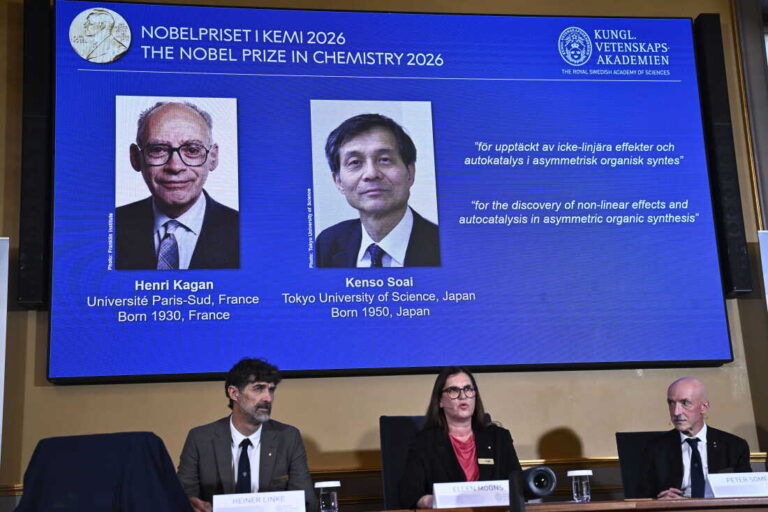
Scientists Henri B. Kagan and Kenso Soai have been awarded the 2026 Nobel Prize in Chemistry for groundbreaking discoveries that helped explain how molecules with a particular “handedness” can emerge and multiply during chemical reactions.
The Royal Swedish Academy of Sciences announced the award Wednesday in Stockholm, honoring the scientists for their work on “non-linear effects and autocatalysis in asymmetric organic synthesis.”
Kagan discovered a new way of manipulating chemical reactions that could produce a much greater excess of one molecular mirror image over another than scientists had previously thought possible.
His breakthrough has had a major impact on asymmetric chemistry, which is particularly important in developing pharmaceuticals, flavors, fragrances and advanced materials.
Soai later developed the first chemical reaction capable of amplifying one molecular mirror image through autocatalysis, in which the product of a reaction helps accelerate its own formation. The discovery became known as the “Soai reaction.”
The Nobel Committee described the experiment as one of the most remarkable in modern chemistry because it provided insight into how a strong preference for one molecular orientation could emerge from extremely small initial imbalances.
“Henri Kagan and Kenso Soai have provided a solution to a chemical mystery that is over a century old: how homochirality can emerge spontaneously,” Heiner Linke, chair of the Nobel Committee for Chemistry, said in announcing the award.
“The chemical reactions they have developed are spectacular,” Linke added.
Homochirality — the tendency of biological molecules to predominantly adopt one of two possible mirror-image forms — is a fundamental characteristic of life and has long presented scientists with questions about how such molecular preferences first developed.
Kagan, 95, was born in France and is affiliated with Université Paris-Sud in Orsay, France.
Soai, who was born in Japan, is affiliated with the Tokyo University of Science.
Their discoveries have advanced scientists’ understanding of asymmetric synthesis while offering new insight into one of chemistry’s longstanding mysteries: how nature came to favor particular molecular forms that ultimately became fundamental to life.