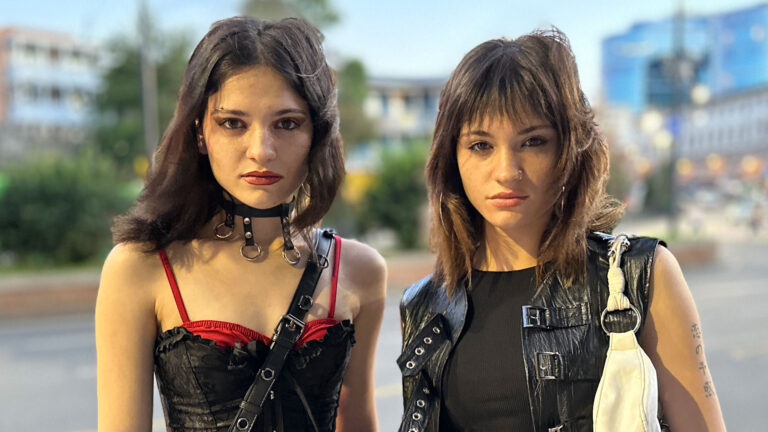
Amy and Ano are identical twins, but just after they were born they were taken from their mother and sold to separate families. Years later, they discovered each other by chance thanks to a TV talent show and a TikTok video. As they delved into their past, they realised they were among thousands of babies in Georgia stolen from hospitals and sold, some as recently as 2005. Now they want answers.
Amy is pacing up and down in a hotel room in Leipzig. “I’m scared, really scared,” she says, fidgeting nervously. “I haven’t slept all week. This is my chance to finally get some answers about what happened to us.”
Her twin sister, Ano, sits in an armchair, watching TikTok videos on her phone. “This is the woman that could have sold us,” she says, rolling her eyes.
Ano admits she is nervous too, but only because she doesn’t know how she will react and if she will be able to control her anger.
It’s the end of a long journey. They have travelled from Georgia to Germany, in the hope of finding the missing piece of the puzzle. They are finally meeting their birth mother.
For the past two years they have been building a picture of what happened. As they unravelled the truth, they realised there were tens of thousands of other people in Georgia who had also been taken from hospitals as babies and sold over the decades. Despite official attempts to investigate what happened, nobody has been held to account yet.
The story of how Amy and Ano discovered each other starts when they were 12.
Amy Khvitia was at her godmother’s house near the Black Sea watching her favourite TV programme, Georgia’s Got Talent. There was a girl dancing the jive who looked exactly like her. Not just like her, in fact, identical.
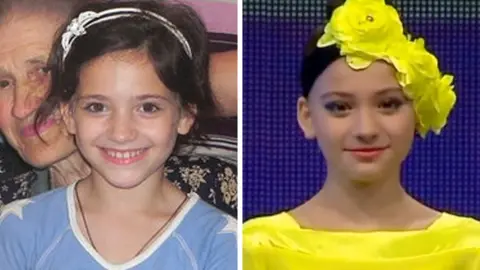
BBC/ Fremantle / Simco Ltd Amy (L) aged 12 and Ano (R) also aged 12 during her performance on Georgia’s Got Talent“Everyone was calling my mum and asking: ‘Why is Amy dancing under another name?'” she says.
Amy mentioned it to her family but they brushed it off. “Everyone has a doppelganger,” her mother said.
Seven years later, in November 2021, Amy posted a video of herself with blue hair getting her eyebrow pierced on TikTok.
Two hundred miles (320km) away in Tbilisi, another 19-year-old, Ano Sartania, was sent the video by a friend. She thought it was “cool that she looks like me”.
Ano tried to trace the girl with the pierced eyebrow online but couldn’t find her, so she shared the video on a university WhatsApp group to see if anyone could help. Someone who knew Amy saw the message and connected them on Facebook.
Amy instantly knew Ano was the girl she had seen all those years ago on Georgia’s Got Talent.
“I have been looking for you for so long!” she messaged. “Me too,” replied Ano.
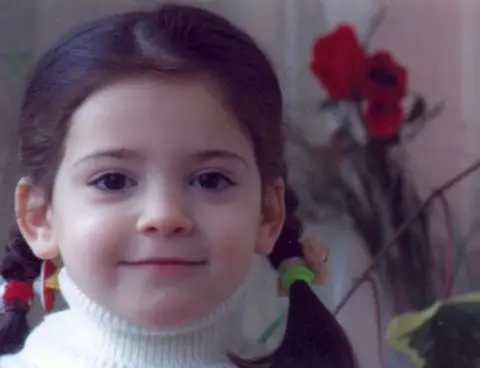
Amy Khvitia Amy Khvitia, here aged four, says she always had the feeling that something wasn’t right in her lifeThey were both born in Kirtskhi maternity hospital – which no longer exists – in western Georgia but, according to their birth certificates, their birthdays were a couple of weeks apart.
They couldn’t be sisters, much less twins. But there were too many similarities.
They liked the same music, they both loved dancing and even had the same hairstyle. They discovered they had the same genetic disease, a bone disorder called dysplasia.
It felt like they were unravelling a mystery together. “Every time I learned something new about Ano, things got stranger,” says Amy.
They arranged to meet and a week later, as Amy approached the top of the escalator at Rustaveli metro station in Tbilisi, she and Ano saw each other in the flesh for the very first time.
“It was like looking in a mirror, the exact same face, exact same voice. I am her and she is me,” says Amy. She knew then that they were twins.
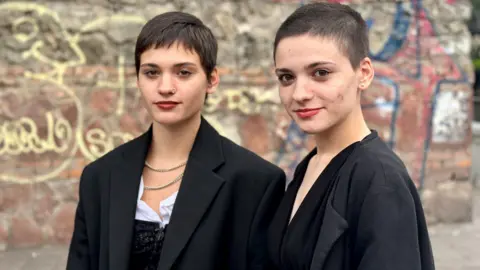
“I don’t like hugs, but I hugged her,” says Ano.
BBC/ Woody Morris Ano (L) and Amy (R) met for the first time at Rustaveli metro station – they have often chosen similar hairstylesThey decided to confront their families and for the first time they learned the truth. They had been adopted, separately, a few weeks apart in 2002.
Amy was upset and felt her whole life had been a lie. Dressed head to toe in black she looks tough, but she fiddles with her studded choker nervously and wipes a mascara-stained tear away from her cheek. “It’s a crazy story,” she says. “But it’s true.”
Ano was “angry and upset with my family, but I just wanted the difficult conversations to be over so that we could all move on”.
Digging deeper, the twins found the details on their official birth certificates, including the date they were born, were wrong.
Unable to have children, Amy’s mother says a friend told her there was an unwanted baby at the local hospital. She would need to pay the doctors but she could take her home and raise her as her own.
Ano’s mother was told the same story.
Neither of the adoptive families knew the girls were twins and despite paying a lot of money to adopt their daughters, they say they hadn’t realised it was illegal. Georgia was going through a period of turmoil and as hospital staff were involved they thought it was legitimate.
Neither family would reveal how much money was exchanged.
The twins couldn’t help wondering if their biological parents had sold them for profit.
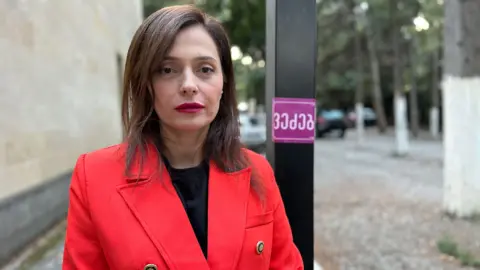
BBC/ Woody Morris Tamuna Museridze set up a Facebook group to help people searching for their biological children, siblings and parentsAmy wanted to search for their birth mother to find out, but Ano wasn’t sure. “Why do you want to meet the person that could have betrayed us?” she asked.
Amy found a Facebook group dedicated to reuniting Georgian families with children suspected to have been illegally adopted at birth and she shared their story.
A young woman in Germany replied, saying her mother had given birth to twin girls in Kirtskhi Maternity Hospital in 2002 and that despite being told they had died, she now had some doubts.
DNA tests revealed that the girl from the Facebook group was their sister, and was living with their birth mother, Aza, in Germany.
Amy was desperate to meet Aza, but Ano was more sceptical. “This is the person who could have sold you, she’s not going to tell you the truth,” she warned. Even so she agreed to go to Germany with Amy to support her.
The Facebook group the twins had used, Vedzeb, means “I’m searching” in Georgian. It has countless posts from mothers who say hospital staff told them their babies had died, but later discovered the deaths weren’t recorded and their children could still be alive.
Other posts are from children like Amy and Ano, looking for their birth parents.
The group has more than 230,000 members and, along with access to DNA websites, has blown wide open a dark chapter in Georgia’s history.
It was set up by journalist Tamuna Museridze in 2021 after she discovered she was adopted. She found her birth certificate with incorrect details when she was clearing out her late mother’s house.
She started the group to search for her own family, but the group has ended up exposing a baby trafficking scandal affecting tens of thousands of people, and spanning decades.
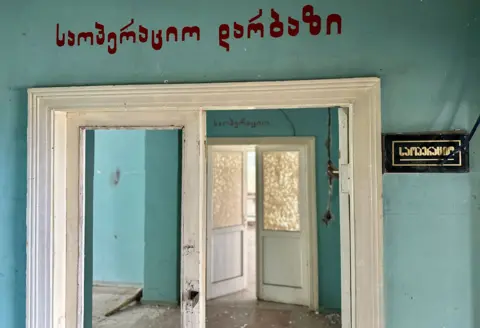
BBC/ Woody Morris The now derelict Gurjaani maternity hospital is one of at least 20 implicated in the sale of babiesShe has helped to reunite hundreds of families, but has not yet tracked down her own.
Tamuna discovered a black market in adoption that stretched across Georgia and went on from the early 1950s to 2005.
She believes it was run by organised criminals and involved people from all sections of society, from taxi drivers to people high up in the government. Corrupt officials would fake the documents needed for the illegal adoptions.
“The scale is unimaginable, up to 100,000 babies were stolen. It was systemic,” she says.
Tamuna explains that she calculated this figure by counting the number of people who have contacted her and combining that with the time frame and the nationwide spread of cases.
With a lack of access to documents – some have been lost and others aren’t being released – it is impossible to verify the exact figure.
Tamuna says many parents told her that when they asked to see the bodies of their dead babies they were told they had already been buried in the hospital grounds. She has since learned that cemeteries at Georgian hospitals never existed. In other cases parents would be shown dead babies who had been frozen in the mortuary.

Tamuna says it was expensive to buy a child, about the equivalent of a year’s salary. She discovered that some children ended up with foreign families in the US, Canada, Cyprus, Russia and Ukraine.
In 2005 Georgia changed its adoption legislation and in 2006 it strengthened anti-trafficking laws, making illegal adoptions more difficult.
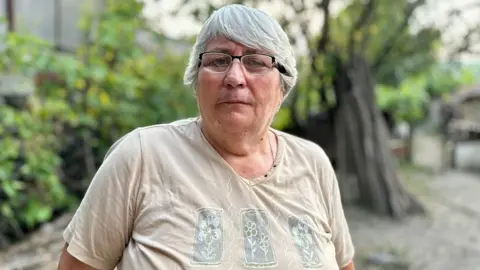
Another person looking for answers is Irina Otarashvili. She gave birth to twin boys in a maternity hospital in Kvareli, in the foothills of Georgia’s Caucasus mountains in 1978.
The doctors told her both boys were healthy but, for reasons that were never explained, they were kept away from her.