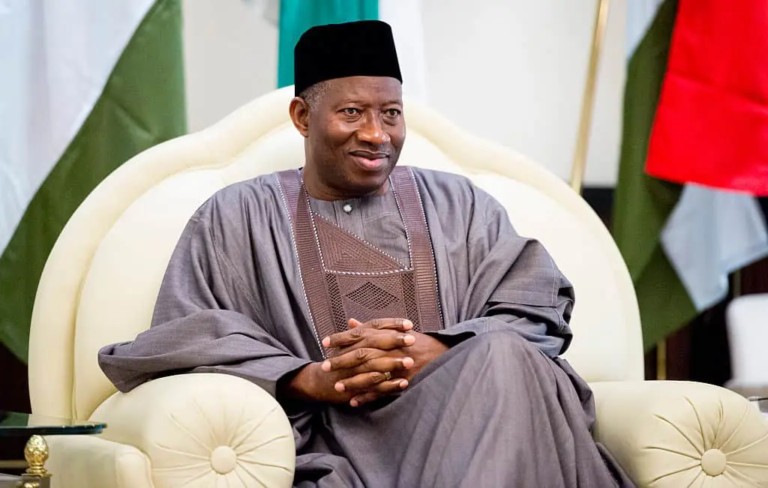
Former President Goodluck Jonathan has described the 2014 abduction of the Chibok schoolgirls as a permanent scar on his presidency and personal life.
Jonathan made the remark on Friday in Abuja during the public presentation of Scars: Nigeria’s Journey and the Boko Haram Conundrum, a book authored by retired Chief of Defence Staff, Lucky Irabor.
“It (the abduction) is a scar I will die with. But perhaps later, more details may become known, and that too has to do with Boko Haram,” the former president said.
Jonathan revealed that during his administration’s attempt to initiate dialogue with the insurgents, Boko Haram nominated Muhammadu Buhari who later succeeded him as president in 2015 to represent them in peace talks.
“In one of the committees we set up then, Boko Haram nominated Buhari to lead their team to negotiate with the government,” he said. “So, I was feeling that if they nominated Buhari to represent them and discuss with the government committee, then when Buhari took over, it could have been easy to negotiate with them and they would have handed over their guns. But Boko Haram is still there till today.”
He noted that Buhari’s inability to end the insurgency underscored its complexity. “If you conduct research and interview many people, you will only get part of the story, but never the full story of Boko Haram,” Jonathan said.
Reflecting on the group’s emergence, he recalled that Boko Haram began in 2009 when he served as vice president under the late Umaru Musa Yar’Adua. Upon assuming office in 2010, he said, his administration spent five years battling the insurgency.
“I thought that after I left, within a reasonable time, General Buhari would wipe them out. But even today, Boko Haram is still there. The issue of Boko Haram is far more complex than it is often presented,” he added.
Jonathan stressed the need for Nigeria to adopt a broader approach to tackling terrorism. “It’s not a single-story issue. As a nation, we must look at Boko Haram differently from the conventional approach,” he said.
While acknowledging that Buhari, who passed away in July 2025, made efforts to end the insurgency, Jonathan maintained that both administrations faced significant challenges in understanding and dismantling the group’s structure.
He expressed optimism that Nigeria would eventually overcome the menace. “I believe one day we will overcome it. Once again, let me thank General Irabor for this, because I always appreciate people who document events clearly,” Jonathan said.
The former president also encouraged military officers who fought in the war against Boko Haram to document their experiences to ensure a complete historical record.
He concluded that the insurgency could not have been driven solely by poverty or hunger, saying his government adopted multiple strategies and interventions aimed at addressing its root causes.