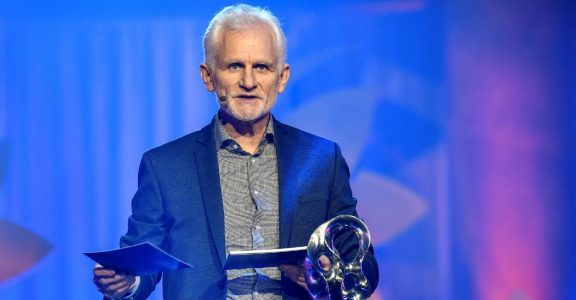
A court in Belarus has sentenced Nobel Peace Prize winner Ales Bialiatski to 10 years in prison.
He was convicted of smuggling and financing “actions grossly violating public order”, the Viasna human rights group said.
Supporters of Mr Bialiatski, 60, say the authoritarian regime of Belarusian leader Alexander Lukashenko is trying to silence him.
Mr Bialiatski was one of three winners of the 2022 Nobel Peace Prize.
Demonstrators were met with police brutality and Lukashenko critics were regularly arrested and jailed during the demonstrations, which started in 2020.
Mr Stefanovich was sentenced to nine years in prison, while Mr Labkovich received seven years, according to Viasna, the group Mr Bialiatski founded in 1996.
All three had pleaded not guilty.
Mr Bialiatski’s wife, Natalya Pinchuk, said the trial was “obviously against human rights defenders for their human rights work”, describing it as a “cruel” verdict.
Referring to her husband’s letters from prison, where he has been held since arrest, she said: “He always writes that everything is fine. He doesn’t complain about his health – he tries not to upset me.”
Belarus’s exiled opposition leader Svetlana Tikhanovskaya said the sentencing was “simply appalling”.
“We must do everything to fight against this shameful injustice and free them,” she said.
Germany’s Foreign Minister Annalena Baerbock described the charges as a “farce”, saying the trio were being punished “simply for their years-long fight for the rights, dignity and freedom of the people of Belarus”.
There are currently 1,458 political prisoners in Belarus, according to Viasna. Authorities claim there are none.
In awarding the 2022 Nobel Peace Prize to Mr Bialiatski, Berit Reiss-Anderson, head of the Norwegian Nobel committee, said the Belarusian government had “for years tried to silence him”.
“He has been harassed, he has been arrested and jailed, and he has been deprived of employment,” she said.
Mr Bialiatski is a veteran of the human rights movement in Belarus, establishing Viasna in 1996 in response to the brutal crackdown of street protests that year by Mr Lukashenko, who has been president of Belarus since the office was established in 1994.
He was jailed for three years in 2011 after being convicted on tax evasion charges, which he denied.
Mr Lukashenko, a close ally of Russian President Vladimir Putin, has been described as Europe’s last dictator.
Increasingly reliant on Moscow for economic, political and military support, he has hosted Russian forces and allowed them to use Belarus as a staging ground for its invasion of Ukraine.
He has been sanctioned for his role in the invasion, as well as for political oppression at home.
Last month he told the BBC he was ready to “wage war” alongside Russia “if someone – even a single soldier – enters our territory from there [Ukraine]”.