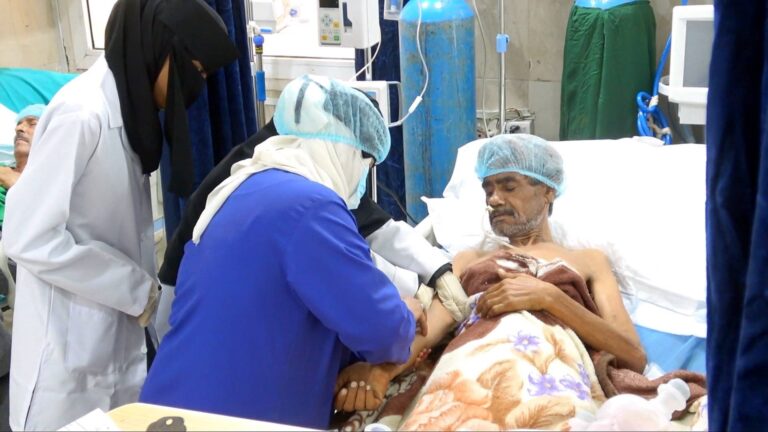
At the Republican Hospital in the government-controlled city, 16-year-old Omar Mukhtar Hammoud is among 270 patients who depend on regular dialysis treatment to survive.
For Omar, whose kidneys can no longer adequately filter waste and excess fluids from his blood, access to the hospital’s dialysis machines is essential.
However, doctors warn that the treatment could soon become unavailable as dwindling fuel reserves and specialized medical supplies threaten to force the facility to suspend operations.
Dr. Essam Mahyoub Dahan, director of the hospital’s dialysis center, said the situation has become increasingly desperate, with a complete shutdown possible within days.
“Because of the siege and the shortage of diesel and medical solutions, we have recently been forced to reduce dialysis sessions from four hours to just two and a half,” Dahan told Al Jazeera.
“We know this is not adequate, but we have no choice if we are to keep the centre operating for as long as possible before it shuts down completely,” he added.
The reduction in treatment time has raised serious concerns about patients’ health, as dialysis is necessary to remove harmful toxins, excess salts and fluids from the bloodstream.
Shortening these sessions can leave patients at greater risk of dangerous complications, particularly those already suffering from advanced kidney failure.
Beyond the fuel shortage, the hospital is also facing a critical lack of specialized dialysis solutions required to operate its machines.
According to Dahan, the center’s remaining supplies are nearly exhausted, leaving medical staff uncertain about how much longer treatment can continue.
The supplies are normally delivered by Yemen’s Ministry of Health every three months.
However, a shipment scheduled to arrive earlier in October has been unable to reach the hospital because of restrictions linked to the renewed siege.
The latest blockade began during the first week of October following Houthi advances in rural areas surrounding Taiz.
The resulting disruption has affected the movement of essential goods into the city, including fuel, food and medical supplies.
For hospitals already struggling with limited resources, the restrictions have intensified an increasingly severe humanitarian situation.
The Republican Hospital’s dialysis center serves approximately 270 patients who require ongoing treatment.
Many of them have few alternatives if the facility is forced to close.
For patients such as Omar, interruptions to dialysis could have life-threatening consequences.
Doctors are attempting to conserve their remaining resources by shortening treatment sessions, but they acknowledge that the measure is only a temporary solution.
Without urgent deliveries of diesel and dialysis supplies, the center may soon be unable to continue providing care.
The current restrictions have revived painful memories of an earlier period in Yemen’s prolonged civil war.
Taiz experienced a complete Houthi siege between 2015 and 2016, when fighting severely disrupted access to food, medicine and other essential services.
The renewed siege has once again raised concerns about the safety and well-being of civilians in the government-held city.
As shortages worsen, medical professionals warn that patients with chronic illnesses are among the most vulnerable.
The crisis highlights the wider humanitarian consequences of Yemen’s ongoing conflict, where disruptions to supply routes can quickly threaten the operation of essential health facilities.
For the hundreds of patients relying on dialysis at the Republican Hospital, the immediate concern is whether lifesaving treatment will remain available in the coming days.
Doctors say restoring access to fuel and medical supplies is urgently needed to prevent the center from shutting down and placing patients’ lives at further risk.