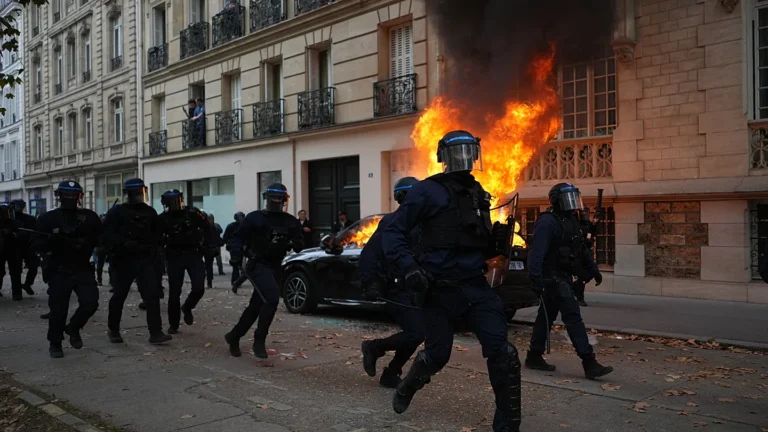
French authorities have deployed thousands of security personnel and imposed strict restrictions on the planned demonstration in an effort to prevent a repeat of last weekend’s violence, which saw businesses looted, vehicles set ablaze and public buildings attacked.
Police have redirected the march away from central Paris, limiting demonstrators to a route along the city’s southeastern edge.
The new route, announced Friday, will run between Porte d’Italie and Porte de Vincennes, replacing the originally planned demonstration from Bastille to Nation.
The decision follows widespread criticism of the government’s handling of previous protests, when groups of masked vandals targeted businesses and public infrastructure in Paris and other major French cities.
Images of burned-out vehicles, damaged shops and violent confrontations with police raised serious questions about the authorities’ ability to maintain public order.
Interior Minister Laurent Nuñez announced that as many as 70,000 police officers and security personnel would be deployed across France to manage the latest demonstrations.
The security operation will include helicopters, armored vehicles and water cannons as authorities prepare for the possibility of renewed clashes.
In central Paris, security forces were already visible near major landmarks, including the Arc de Triomphe, where gendarmes were stationed along surrounding avenues.
Officials are seeking to prevent violent groups from infiltrating the demonstrations and causing further destruction.
The heightened security measures come after more than half a million people participated in protests across France last weekend.
Another substantial turnout is expected Saturday, reflecting continued public frustration over economic pressures and conditions in the country’s education system.
The protest movement began last month over staff shortages at a high school southeast of Paris but has since evolved into a broader campaign addressing economic and social concerns.
Students are demanding more teachers, improved school facilities and expanded access to university education.
Trade unions have joined the demonstrations, calling for higher wages and pensions to help workers and retirees cope with rising everyday expenses.
The movement has brought together different groups dissatisfied with government policies and the increasing financial pressure facing households.
Although the demonstrations have largely focused on education funding and the cost of living, previous protests were overshadowed by violence involving masked individuals who vandalized property and clashed with police.
The threat of further disturbances has forced several of Paris’ leading cultural institutions to close their doors Saturday.
The Louvre, Musée d’Orsay, Picasso Museum and Grand Palais are among the major attractions affected by the security concerns.
The Grand Palais had been hosting a major exhibition dedicated to French painter Paul Cézanne.
Meanwhile, Art Basel, one of the world’s leading contemporary art fairs, opened to the public Friday but canceled its weekend program because of fears surrounding the demonstrations.
The closures represent a significant disruption to the city’s cultural and tourism activities.
Business owners have also taken precautionary measures, with many boarding up storefronts to protect against possible looting and vandalism.
Near Saint-Lazare railway station, 34-year-old contractor Akram Ahmed was seen installing protective boards over an optician’s shop as businesses prepared for another potentially tense weekend.
The latest demonstrations present another major challenge for the French government as it attempts to respond to public demands while preventing further violence.
Authorities face pressure to protect businesses, cultural institutions and residents without undermining the right to peaceful protest.
For students and workers, the demonstrations are an opportunity to demand improvements in education, wages and living standards.
For police and government officials, the immediate priority is preventing the disorder that disrupted several French cities last weekend.
With large crowds expected and an extensive security operation underway, Saturday’s demonstrations will be a significant test of the government’s ability to maintain order while addressing growing public dissatisfaction.