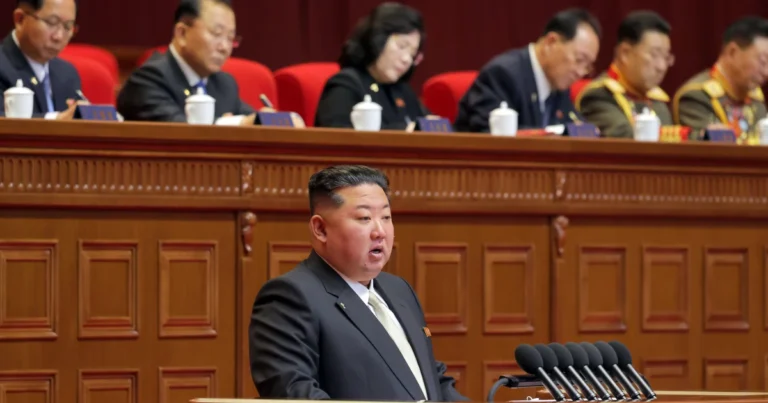
North Korean leader Kim Jong Un praised what he described as steady economic gains and a strengthened regional position as he opened the country’s ruling party congress, a key political gathering expected to shape North Korea’s domestic and foreign policy direction for the next five years.
According to the state-run Korean Central News Agency, the Workers’ Party Congress began Thursday in Pyongyang, with Kim delivering a speech focused largely on economic development. State media did not immediately report remarks directly addressing tensions with the United States or South Korea, nor did it detail any discussion of the country’s nuclear weapons program — issues that remain central to international concerns.
Kim told delegates that the country had achieved “significant progress” since the previous congress in 2021, which was held amid the economic and public health strain of the COVID-19 pandemic. He cited improvements in economic performance and what he characterized as an “irreversible” strengthening of the state’s standing in the region.
“This created favorable conditions and circumstances for giving a greater spur to our socialist construction,” Kim said, according to KCNA. He added that the party faces “heavy and urgent historic tasks” to boost economic growth, improve living standards and reform various sectors of state and social life.
KCNA said the congress would set major policy objectives for the coming years and reinforce the organizational capacity of the ruling Workers’ Party but offered few specifics on the agenda.
In recent years, Kim has deepened ties with Russia amid Moscow’s war in Ukraine, reportedly supplying troops and military equipment in exchange for economic support and advanced military technologies. He has also sought to reinforce relations with China, North Korea’s main economic partner, including a visit to Beijing last year and his first summit in six years with Chinese President Xi Jinping.
The congress is widely seen as an opportunity for Kim to consolidate authority further while outlining long-term strategies for economic management, security policy and international alignment.