The Pentagon is deploying additional military assets to the Middle East — including warships, air defense systems and submarines — as the United States prepares for the possibility of military action against Iran if Donald Trump authorizes a strike, according to U.S. officials and publicly available ship-tracking data.
The buildup comes as Washington and Tehran continue diplomatic efforts aimed at preventing open conflict. Iranian Foreign Minister Abbas Araghchi said there had been “good progress” following indirect talks in Geneva with Trump’s special envoy, Steve Witkoff, and adviser Jared Kushner. White House press secretary Karoline Leavitt said Wednesday that discussions had yielded “some progress,” but noted that significant details remain unresolved.
Key differences persist. The Trump administration is demanding that Iran accept new restrictions on both its nuclear program and its missile development — conditions Tehran has so far rejected.
Senior national security officials met Wednesday in the White House Situation Room to assess options, according to a senior administration official. No final decision has been made regarding military action, and the U.S. is awaiting a written Iranian response addressing outstanding disputes. Officials indicated that necessary U.S. forces for potential operations could be fully positioned by mid-March.
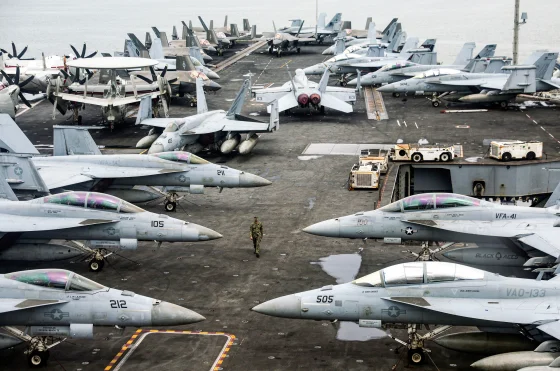
Among the reinforcements is the USS Gerald R. Ford, which is crossing the Atlantic and is expected to enter the Mediterranean Sea in the coming days. A nuclear submarine is already operating in the region. Once in position, the carrier will join the USS Abraham Lincoln strike group currently in the Persian Gulf.
Additional naval assets in the region include littoral combat ships, a guided-missile destroyer in the Red Sea, and two guided-missile destroyers near the Strait of Hormuz, according to U.S. Naval Institute tracking.
Iran has repeatedly warned it would block the Strait of Hormuz — a critical maritime corridor through which roughly 20% of global oil supply passes — if attacked. Iranian state media reported this week that portions of the strait were temporarily closed for “security precautions” during military exercises conducted by the Islamic Revolutionary Guard Corps.
The positioning of aircraft carriers and accompanying warships would allow the United States to conduct operations without relying on airbases in Arab Gulf states, whose governments have expressed reluctance to permit offensive strikes from their territory due to fears of Iranian retaliation.
It remains unclear whether any military action would be conducted solely by U.S. forces or in coordination with Israel. Secretary of State Marco Rubio is expected to travel to Israel later this month to meet with Prime Minister Benjamin Netanyahu, amid Israeli concerns over the status of negotiations with Tehran.
The current military posture mirrors preparations that preceded U.S. airstrikes on three Iranian nuclear facilities in June, an operation the Pentagon said lasted less than 30 minutes. Analysts suggest that any future strike could be broader in scope, particularly if aimed at inflicting sustained damage on Iran’s military or governing infrastructure.
For now, diplomatic engagement continues alongside military contingency planning, as both sides weigh the risks of escalation.