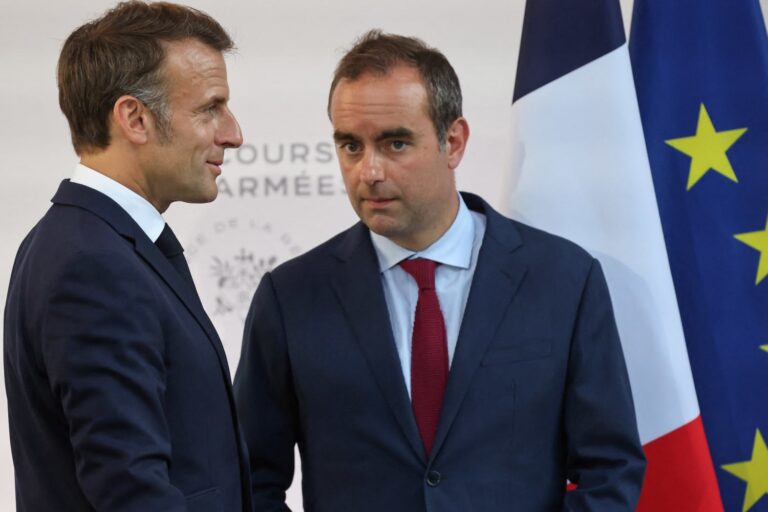
In a stunning reversal, French President Emmanuel Macron has reappointed Sébastien Lecornu as prime minister just four days after his resignation, signaling a desperate effort to restore political stability amid mounting legislative paralysis and economic strain.
The Élysée Palace confirmed the move late Friday, following tense consultations between Macron and centrist party leaders — notably excluding far-right and far-left figures. Lecornu’s return comes despite his public insistence earlier in the week that he was not seeking to reclaim the post.
“I am not chasing the job, my mission is over,” Lecornu had said on national television just two days prior.
Nevertheless, the 39-year-old Macron loyalist now returns with sweeping authority. According to a statement from the president’s office, Lecornu has been granted “carte blanche” to form a new government.
Posting on X (formerly Twitter), Lecornu acknowledged the weight of the challenge:
“Out of duty, I accept the mission entrusted to me by the president — to deliver a national budget before year’s end and address the everyday concerns of our fellow citizens.”
Lecornu, known for his austere “soldier-monk” persona, promised to do “everything to succeed in this mission.”
Lecornu’s reinstatement comes just days before Monday’s deadline to present France’s 2025 national budget — a formidable task given the fractured state of the National Assembly and record-low presidential approval ratings.
France’s public debt has soared to 114% of GDP, placing it among the highest in the eurozone. The budget deficit is projected to reach 5.4% of GDP this year. Lecornu has made fiscal discipline a non-negotiable priority, warning that all parties must confront the need for financial reform.
However, the new premier must first survive a confidence vote in a parliament where Macron’s centrist alliance no longer holds a majority. The political cost of failure could be enormous.
Lecornu’s return has been met with fierce backlash from the far right.
“This is a bad joke,” said Jordan Bardella, leader of the National Rally. “The president is more isolated than ever in the Élysée.”
Bardella announced his party would immediately table a vote of no confidence, calling the centrist coalition “doomed” and held together only by “fear of facing the electorate.”
Meanwhile, conservatives also remain deeply skeptical. Bruno Retailleau, head of the conservative Republicans — and a likely 2027 presidential hopeful — has refused to back Lecornu, calling “Lecornu II” a non-starter.
The previous government collapsed just three weeks after its formation due to infighting with Retailleau’s bloc over ministerial appointments.
In an effort to build a working coalition, Lecornu is now reaching out to left-wing parties. Macron’s camp has even floated a partial delay in implementing the controversial pension reform that raised the retirement age from 62 to 64.
The overture has drawn mixed reactions.
“We’ve been given no guarantees, so we’ll give none in return,” said Socialist leader Olivier Faure.
“A prime minister from the president’s centrist camp won’t be accepted by the French people,” warned Communist Party chief Fabien Roussel.
Green Party leader Marine Tondelier said she was “stunned” by Macron’s approach, predicting that “all of this is going to turn out very badly.”
The maneuver risks alienating Macron’s center-right allies — many of whom helped pass the pension law last year — while still failing to secure meaningful support from the left.
The political chaos is already taking its toll on the economy. The Bank of France forecasts 0.7% growth for 2025, but Governor François Villeroy de Galhau warned that instability has already shaved 0.2% off that figure.
“Like many in France, I’ve had enough of this political mess,” Villeroy told RTL radio. “It’s time for compromise — that’s not a dirty word, even if it means forming coalitions.”
Analysts warn that failure to form a stable government could plunge France into deeper uncertainty — spooking financial markets and further eroding public trust in the political system.
Macron’s decision to bring Lecornu back underscores both the depth of France’s political deadlock and the president’s narrowing room to maneuver.
With just 18 months left in his term, Macron is betting that a familiar face — now armed with broader powers — can navigate a treacherous political landscape, secure a budget, and restore credibility.
But with a divided parliament, emboldened opposition, and a weary public, Lecornu’s second term as prime minister may prove even more fragile than the first.