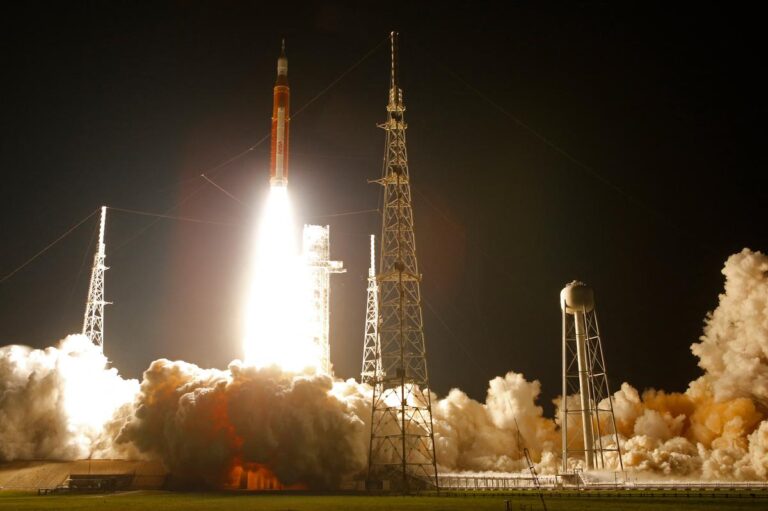
The American space agency Nasa has launched its most powerful ever rocket from Cape Canaveral in Florida.
The 100m-tall Artemis vehicle climbed skyward in a stupendous mix of light and sound.
Its objective was to hurl an astronaut capsule in the direction of the Moon.
This spacecraft, known as Orion, is uncrewed for this particular flight, but if everything works as it should, people will climb aboard for future missions that go to the lunar surface.
Wednesday’s flight followed two previous launch attempts in August and September that were aborted during the countdown because of technical woes.
But such issues were overcome on this occasion, and the Space Launch System, as the rocket is often called, was given the “go” to begin its ascent from the Kennedy Space Center at 01:47 local time (06:47 GMT).
“Today, we got to witness the world’s most powerful rocket take the Earth by its edges and shake the wicked out of it,” said Mike Sarafin, Nasa’s Artemis mission manager. “We have a priority one mission in play right now.”
His boss, the agency’s administrator Bill Nelson, was also wowed by what he saw.
“That’s the biggest flame I’ve ever seen. It’s the most acoustical shockwave that I have ever experienced,” he commented. “I have to say what we saw tonight was an A+. But we have still a long ways to go. This is just a test flight.”
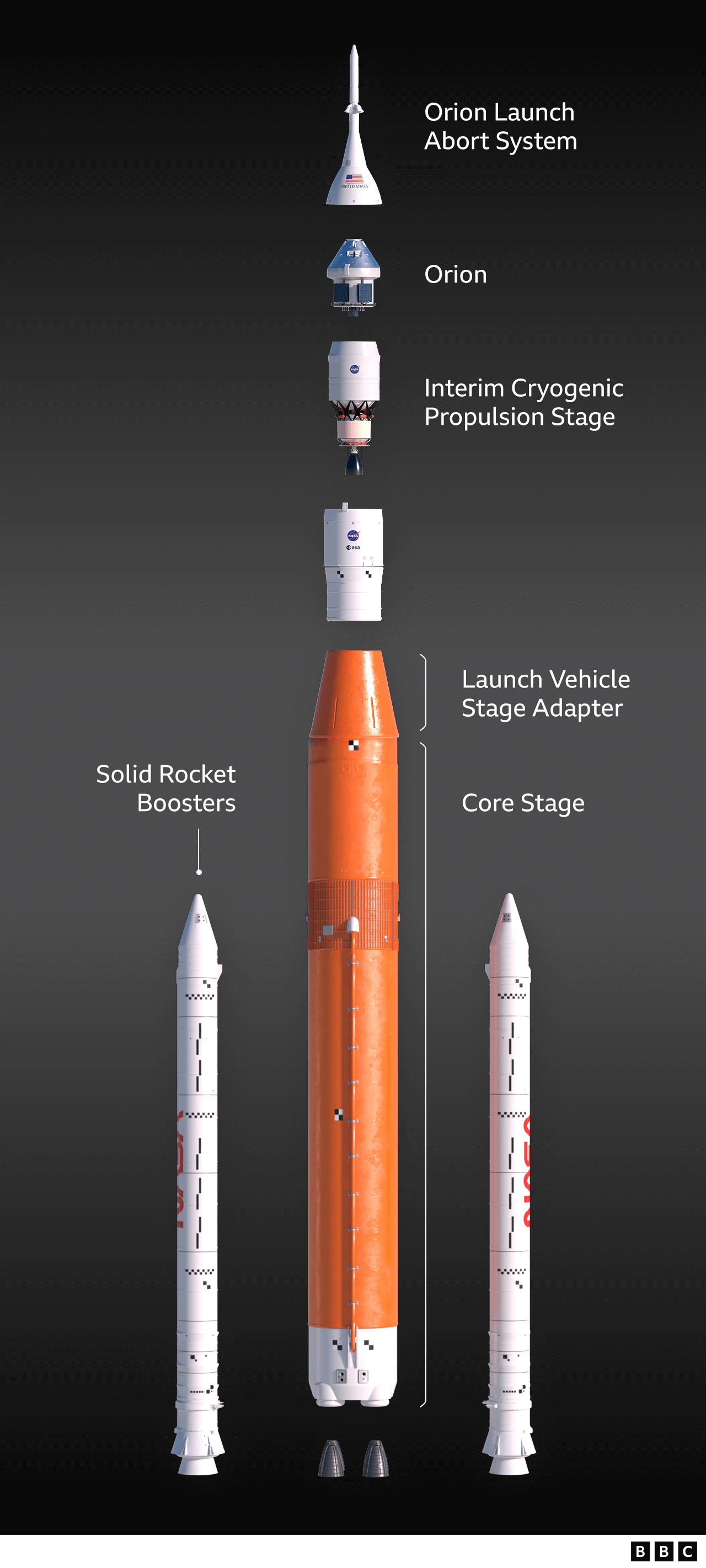
The rocket had a number of important manoeuvres to perform high above the planet to get the Orion capsule on the right path to the Moon. All were performed “outstandingly”, said John Honeycutt, Nasa’s SLS programme manager.
The ship will now rely on its European propulsion module to shepherd it safely on the rest of the mission.
“And there’ll be some critical manoeuvres from our service module, too, as we fine tune the direction of flight of Orion,” Dr David Parker, the European Space Agency’s director of human spaceflight, told BBC News.
“One of the really exciting moments will come when we do the orbit insertion into this very interesting path around the Moon, going far beyond the Moon for the first time.”
December will see Nasa celebrate the 50th anniversary of Apollo 17, the very last time humans walked on the Moon.
The space agency is calling its new programme Artemis (Apollo’s twin sister in Greek mythology).
It’s planning a series of ever more complex missions over the next decade that should result in a more sustained presence at Earth’s satellite, with the presence of surface habitats and the use of rovers, together with a mini space station in orbit around the Moon.
Nasa hopes it will be a new inspiration for a new age. It has promised that women and people of colour will feature in these endeavours, something that didn’t happen 50 years ago.
“I wanted to be an astronaut from the time that I was five years old.” said astronaut Jessica Meir. “For anybody that has a dream or some kind of aspiration, if they see somebody that they can identify with a little bit, it puts them into a totally different perspective where they can say, ‘Well, wait a minute, that person was just like me, and they did it so I can do it too’.”
BBC