Chinese President Xi Jinping has outlined China’s ambition to become a leading global force in artificial intelligence, calling for greater international cooperation and stronger safeguards as Beijing seeks to expand its influence over the rapidly developing technology.
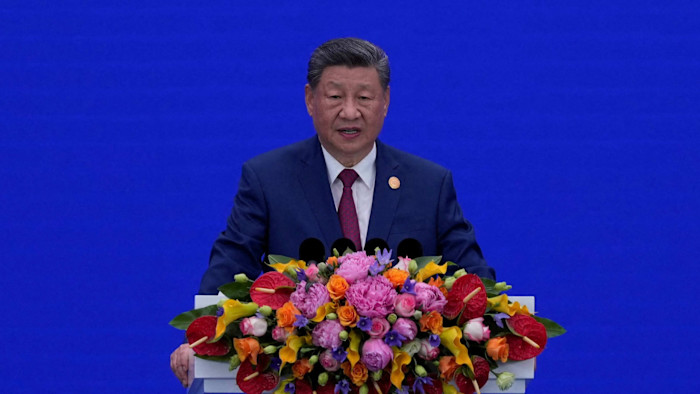
Speaking at an AI conference in Shanghai on Friday, Xi warned that the extraordinary pace of artificial intelligence development requires governments to establish effective oversight while ensuring the technology advances in what he described as a “positive direction.”
As AI develops at a “staggering speed,” Xi said authorities must more accurately balance regulation and governance while improving measures designed to prevent the technology from spiraling out of control.
His remarks came a day after nearly 30 countries, including Russia, Brazil and Indonesia, joined the newly established World Artificial Intelligence Cooperation Organization.
Xi described the creation of the group as an “important milestone in the history of AI development.”
The organization could provide Beijing with greater influence over areas including international AI governance and technical standards as Chinese artificial intelligence companies increasingly compete with U.S. firms for global market share and technological leadership.
A commentary published this week by China’s state-run People’s Daily also highlighted concerns surrounding the technology, warning that the risks associated with AI are becoming increasingly significant and require stronger governance.
Xi said the new initiative reflected China’s efforts to respond to the needs of developing nations and encourage broader international participation in shaping the future of artificial intelligence.
“AI should not be a solo performance by a single country but a symphony of international cooperation,” Xi said.
China’s domestic AI industry has made rapid advances in recent years, with startups releasing increasingly sophisticated large language models that have narrowed the technological gap with leading American developers.
Chinese AI startup Moonshot recently unveiled a new large language model with capabilities approaching those developed by leading U.S. AI laboratories.
Beijing has also increasingly incorporated artificial intelligence into its diplomatic and economic engagement with developing countries.
Xi announced that China would provide 5,000 AI training and seminar opportunities for developing nations over the next five years. Beijing also plans to establish international AI application cooperation centers to help other countries strengthen their technological capabilities.
During a meeting with Kazakh President Kassym-Jomart Tokayev in Shanghai, Xi said China was prepared to share expertise in the digital economy and artificial intelligence to support Kazakhstan’s digital transformation.
Meanwhile, China’s National Development and Reform Commission unveiled an action plan pledging to promote open-source artificial intelligence technologies internationally.
The plan aims to help other countries develop AI systems using open-source models, positioning Chinese technology as a potentially lower-cost alternative to proprietary Western platforms.
The initiatives underscore Beijing’s broader strategy to expand China’s role in shaping global AI development, governance and standards as competition with the United States for technological leadership continues to intensify.