President Bola Ahmed Tinubu on Tuesday called on the World Bank to deepen and accelerate its partnership with Nigeria, reaffirming that his administration remains firmly committed to sustaining its economic reforms despite the initial pains of adjustment.
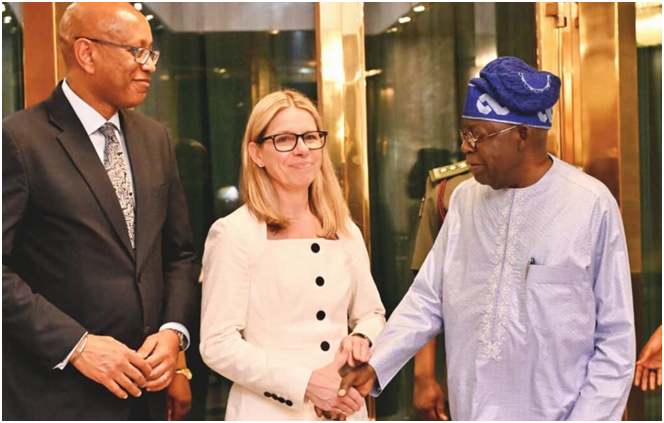
The President made the call at the State House, Abuja, while receiving a high-level World Bank delegation led by its Managing Director of Operations, Anna Bjerde. He said Nigeria had already passed through the most difficult phase of reform implementation and was determined to stay the course in the interest of long-term stability and prosperity.
“I give you the assurance that since we’ve gone into this tunnel of reform, we have our hands on the plough and we’re never going to look back. Initially it was painful and difficult, but those who win are not the ones who give up along the way in difficult times,” Tinubu said.
Describing Nigeria as the heart of the African continent, the President stressed that the country’s population size and vast resources made reforms not only desirable but inevitable. He urged the World Bank to support Nigeria’s reform agenda, particularly in agriculture, youth employment and private sector growth, as part of efforts to strengthen the economy and expand opportunities for Nigerians.
Tinubu emphasised the need to modernise and mechanise agriculture to boost productivity and create jobs for the country’s large youthful population. He said the government had established mechanisation centres to support farmers with improved seedlings and fertilisers, with the aim of moving them from small-scale holdings to large cooperatives capable of creating wealth and employment.
“We have mechanization centers to help farmers with improved seedings and fertilizers to enhance their programs. The goal is to move farmers from small-scale holders to large cooperatives that can create opportunities for Nigerians,” he said.
The President also highlighted the petrochemical sector and other domestic industries as priority areas for increased output and stronger local markets. He noted that reforms must be continuous and anchored on transparency, accountability and stability.
“The first reaction to reforms was high inflation, but it has come down dramatically, and the Naira is now stable. We want to help investors operate with ease, reduce bureaucracy, and develop the skills of our people,” Tinubu said.
Reaffirming his administration’s reform philosophy, Tinubu said difficult decisions such as fuel subsidy removal and exchange-rate unification were necessary sacrifices for long-term gains.
“It’s difficult for a leader to look the other way in a corrupt environment where subsidy regimes or multiple exchange rates can offer quick gains. We gave that up so that the world and the country can benefit from a stable currency,” he said.
He added that easing inflation and stabilising the naira were already improving investor confidence and making it easier to do business in and out of the country. Tinubu urged the World Bank to explore innovative financing models, reduce bureaucratic bottlenecks, help de-risk private investment and support skills development.
“How can you accelerate growth in your partnership with us is very important to me,” the President said, adding that Nigeria remained open to expanded engagement at any time.
In her remarks, Anna Bjerde commended Tinubu’s administration for what she described as steady, disciplined and courageous reform leadership over the past two years. She said Nigeria had become a global reference point for reform implementation, boosting confidence among investors and policymakers worldwide.
“The results achieved in the last two years are commendable. Your steady communication of the importance of reforms has given confidence and clarity, and there is no turning back,” Bjerde said.
She identified job creation, particularly for young people, as a key priority, noting that agriculture remained a major employer. According to her, scaling mechanisation, cooperatives, value-chain development and infrastructure could significantly expand employment opportunities.
Bjerde disclosed that the World Bank’s public-sector financing portfolio in Nigeria stood at about $17 billion, while private-sector support through the International Finance Corporation amounted to roughly $5 billion annually. She added that the Multilateral Investment Guarantee Agency had expanded investment guarantees beyond $500 million to attract private capital.
She also revealed that the World Bank was preparing a new budget-support operation aligned with Nigeria’s reform agenda, noting that the forthcoming Country Partnership Framework would be anchored on Nigeria’s development vision, including the ambition to grow the economy to $1 trillion and achieve annual growth of about seven per cent.
Earlier, the Minister of Finance and Coordinating Minister of the Economy, Wale Edun, said the meeting took place as Nigeria and the World Bank were finalising the Country Partnership Framework for 2026–2032. He described the engagement as evidence of a shared commitment to deepening a partnership focused on structural transformation and sustainable growth.
Edun said reforms under the Renewed Hope Agenda had repositioned Nigeria’s economy for long-term resilience, with progress already acknowledged by rating agencies and global investors. He noted that the new framework would prioritise infrastructure, transport, power, agriculture, human capital development and digitalisation.
According to him, Nigeria was shifting from heavy reliance on sovereign borrowing to mobilising large-scale private sector investment, with government playing a catalytic role in de-risking projects. He added that the World Bank remained a trusted partner expected to scale guarantees, blended finance and risk-sharing instruments to unlock billions of dollars in global investment.
Edun said the presence of the high-level World Bank delegation was a strong signal of confidence in Tinubu’s leadership and reform direction, stressing that the focus going forward was to sustain momentum and entrench credible, long-term economic growth.