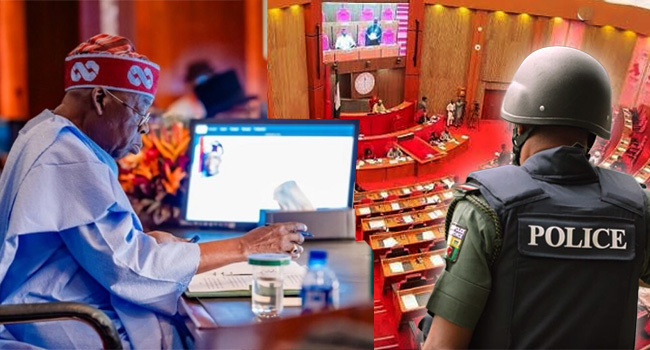
President Bola Tinubu has received the constitutional amendment bill seeking to introduce State Police, bringing the proposed decentralisation of policing a step closer to implementation.
The document was delivered to the President on Wednesday by his Special Advisers on Senate and House of Representatives Matters, Senator Basheer Lado and Wasiu Olanrewaju-Smart.
Tinubu’s Chief of Staff, Femi Gbajabiamila, who disclosed the development, said the President would consult Attorney-General of the Federation, Lateef Fagbemi, before proceeding with a formal signing ceremony.
Beyond the constitutional amendment, the government is also working on a National Policing Bill to establish the legal and operational structure for the proposed state-controlled police formations.
Gbajabiamila, who chairs the Presidential Working Group on State Police, said the group had completed extensive consultations with stakeholders across the country. He added that its draft legislation was currently with the Federal Ministry of Justice for legislative drafting validation.
“Upon receipt of the validated version, the Working Group will review it and present it, alongside its report, to Mr President for consideration,” he said.
The President also acknowledged the contributions of the National Assembly leadership, lawmakers, state governors, State Houses of Assembly and Nigerians towards finding solutions to the country’s security challenges.
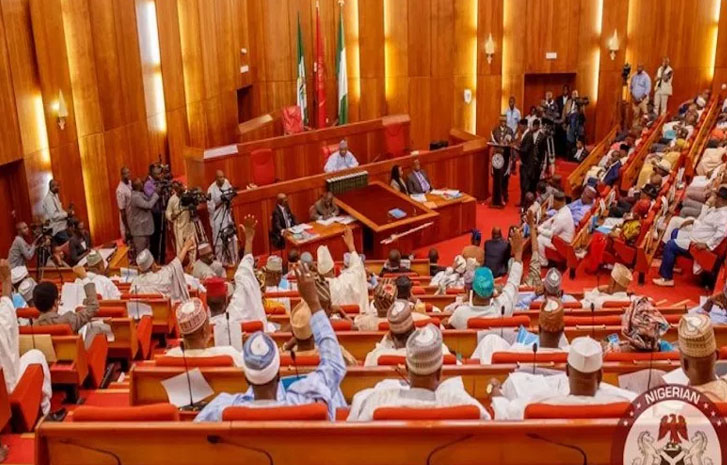
Tinubu’s receipt of the bill follows the Senate’s directive to the Clerk of the National Assembly to forward the amendment for presidential assent. Lawmakers also called on the Executive to submit the National Policing Bill for legislative scrutiny and expeditious passage.
The Senate’s position followed a motion moved by its Leader, Opeyemi Bamidele, during Wednesday’s plenary.
The constitutional amendment secured the required legislative backing after all 36 State Houses of Assembly approved it. Clerk to the National Assembly, Kamoru Ogunlana, announced the development on Monday, confirming that the approval surpassed the minimum 24 state assemblies required under Section 9(2) of the 1999 Constitution, as amended.
Concerns Over State Police
The proposed restructuring of Nigeria’s policing system has continued to attract support and criticism amid persistent security threats across the country.
Advocates say allowing states to operate their own police forces would improve local intelligence, strengthen community security and enable quicker responses to threats that may not receive adequate attention under the centralised system.
However, critics have raised concerns about the possibility of governors using state police to intimidate political opponents, alongside questions about funding and accountability.
In September 2025, House of Representatives member Yusuf Gadgi argued that properly funded community policing would deliver better results than State Police. He warned that placing police commands under governors could worsen insecurity.
Regional security organisations such as Amotekun in the South-West have also faced operational challenges, including restrictions on access to superior weapons.
Human rights lawyer Femi Falana has supported decentralised policing but called for clearly defined jurisdictions and legal safeguards to prevent political abuse and clashes between security agencies.
He further maintained that State Police would not independently resolve Nigeria’s security problems without tackling poverty and unemployment.