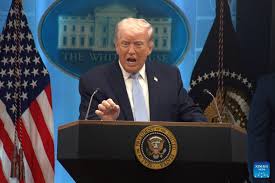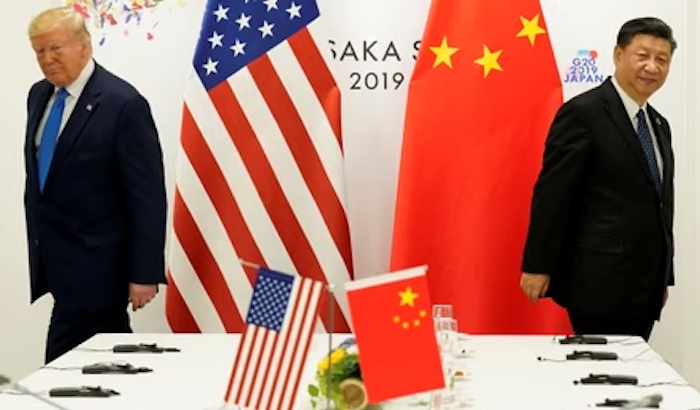
A blistering new report from Democratic members of the U.S. Senate Foreign Relations Committee accuses President Donald Trump of weakening America’s global standing and paving the way for China to expand its influence and challenge U.S. leadership on the world stage.
Released Monday, the report evaluates the first six months of Trump’s second term, concluding that his administration has “significantly undermined” the United States’ ability to compete strategically with China. Among the concerns cited are sweeping staff cuts at the State Department, the scaling back of foreign aid programs like USAID, and the dismantling of the U.S. Agency for Global Media—all of which the report claims have eroded America’s diplomatic and informational tools.
“While President Trump retreats from every corner of the world—attacking allies, slashing America’s diplomatic tools, and embracing adversaries—China is building influence, expanding relationships, and reshaping the global order to its advantage,” said Senator Jeanne Shaheen, a senior Democrat on the committee.
The report describes China as “a strategic challenge distinct from any in our nation’s history,” warning that Beijing’s long-term plan is aimed at displacing the U.S. as the dominant global power.
The findings coincide with a new Pew Research Center survey showing a significant shift in global public opinion toward China. In 15 of 25 countries surveyed—including Mexico, Indonesia, South Africa, Kenya, and Türkiye—views of China have improved over the past year. While a 54% median of respondents still hold negative views of China, more now see it as the world’s leading economic power: 41% identified China as the top economy, compared to 39% who said the U.S.
Perhaps most striking is the drop in global confidence in U.S. leadership. In 10 high-income countries—among them the UK, Canada, Germany, Japan, and South Korea—favorable views of the U.S. fell from 51% in 2024 to 35% in 2025. Confidence in President Trump has plunged to 22%, down from 53% under President Biden, and now trails Chinese President Xi Jinping, who rose slightly from 17% to 24%.
“Trump’s trade war has fostered much deeper skepticism and distrust of the United States across Asia today,” said Ian Chong, a political science professor at the National University of Singapore. “For some, cooperation with China appears to be an attractive alternative.”
The report also criticizes Trump’s withdrawals from major international agreements like the Paris Climate Accord and the World Health Organization—decisions that Democrats argue left a diplomatic vacuum which Beijing has eagerly filled. China has expanded its presence in regions across Africa, Southeast Asia, and Latin America through increased foreign aid, infrastructure investment, and diplomatic engagement.
“China is increasingly seen as a more reliable business partner amid the uncertainty emanating from the U.S.,” said William Yang, Northeast Asia analyst at the International Crisis Group. “Many countries are stabilizing their relationships with China through high-level bilateral exchanges.”
As the Biden administration’s foreign policy is being reversed, the report warns that if current trends continue, the U.S. risks losing its long-held role as a global leader in favor of a rising and strategically assertive China.