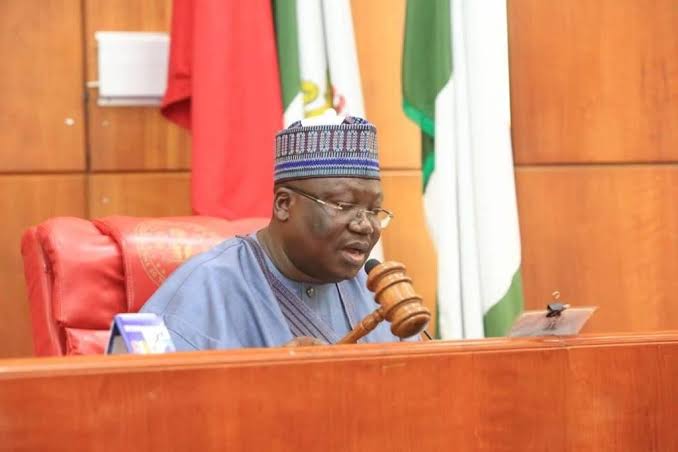
Under the 2018-2020 external borrowing (rolling) plan, the Senate had on Wednesday accepted President Muhammadu Buhari’s request to borrow $16,230,077,718; €1,020,000,000; and a grant component of $125,000,000.
The approval came after the committee’s report on domestic and foreign debt was reviewed and approved.
The Nigeria debt stock of N35.5tn will rise to N42.7tn following the Senate’s approval of the Federal Government’s request for $16bn and €1.02bn fresh loans.
The $16.2bn loans is equivalent to N6.7tn using the Importers and Exporters’ Window exchange rate of N411.24/$1, while the €1.02bn is equal to N485.5bn using the Central Bank of Nigeria’s exchange rate f N476/ €1. These bring the value of the loans to be acquired to N7.2tn.
The loans were, however, approved without the terms and conditions as the Senate urged President Buhari to forward the terms of the loan to the Upper Chamber.
President Muhammadu Buhari had, in a letter read on the floor of the Senate on September 15, 2021, requested the lawmakers to approve the loans.
The loans, Buhari said, were to finance critical infrastructural projects across the country.
The senator explained that out of the total amount approved by the National Assembly, $3,529,300,000 would be sourced from the World Bank.
He said $5.07bn would be sourced from the China Exim Bank; and $3.9bn from the Industrial and Commercial Bank of China.
Ordia stated that $2.8bn was being expected from the China Development Bank; and $698m from the Africa Development Bank.
He added that €345m was being expected from the French Development Agency; €175m from the European Investment Bank; and $190m from the European ECA/KfW/IPEX/AFC.
The lawmaker also said €500m would be sourced from the international capital market; and $62.1m from Standard Chartered Bank/SINOCURE.
Ordia explained that the committee noted the serious concerns of Nigerians about the level and sustainability of the country’s borrowing in the last decade.
He, however, said Nigeria’s debt figures, which continue to increase, reached an all-time high of around 95 percent of retained revenue and 35 percent of its annual expenditure.
The senator said the development constituted a drain on the nation’s economy and limited resources available for national development.
Underscoring the need for a more proactive approach to revenue enhancement, the lawmaker observed that “there are noticeable improvements in our revenues, but the growth is not sufficient or rapid enough to catch up with the pace of development required for our nation.”
Expert view on Nigeria borrowing
The Chief Executive Officer, SD&D Capital Management, Idakolo Gbolade, told The PUNCH that although borrowing was not bad, the projects for which the loans were being sought should be able to pay back the debts.
“The government borrowing to fund infrastructure is not bad, but the problem is that the projects should be made to repay the loans. The government needs to look into this. For example, projects like roads should be tolled and proceeds used for repayment as well as railways, etc,” he said.
Gbolade added that although the country was still within the appropriate debt ratio, more borrowings would put the country in unfavorable conditions, which would jeopardize the future of unborn generations.
“Presently, Nigeria is still within the debt ratio, according to World Bank standards, but further borrowings with conditions that are not favorable to our sovereignty should be adequately examined in order not to put generations yet unborn in perpetual debt,” he added.
The Chief Executive Officer, Economic Associates, Dr. Ayo Teriba, urged the government to restructure its debt portfolio.
He said, “Nigeria should aggressively restructure its debt portfolio by replacing interest-paying commercial bonds with interest-free commercial bonds on a wholesale basis to drastically reduce or eliminate the N4.9tn annual average interest payments that are projected in the 2022-2024 MTEF.
“Rather than issue interest-paying bonds to fund infrastructure, we should create special purpose vehicles for packaging infrastructure assets for interest-free financing through asset-linked non-convertible or convertible bonds. Ideally, this should happen in a rule-based fiscal regime with an independent advisory fiscal commission as a watchdog.”
Ada Peter