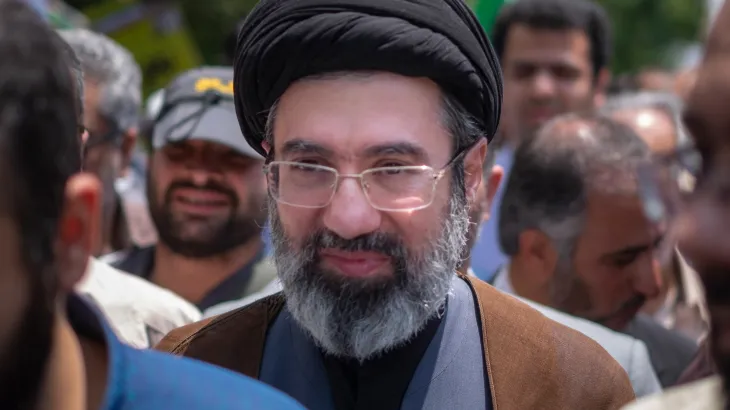
Iran has appointed Mojtaba Khamenei as its new supreme leader, roughly a week after the killing of his father, Ali Khamenei, in joint U.S.-Israeli strikes that have plunged the Middle East into a widening conflict.
The Assembly of Experts, the constitutional body responsible for selecting Iran’s supreme leader, formally named the 56-year-old cleric as the country’s new leader on Sunday. He now faces the task of guiding Iran through one of the most serious crises in the Islamic Republic’s 47-year history.
Soon after the announcement, key institutions across Iran’s political and military establishment pledged their support, including the Islamic Revolutionary Guard Corps and the country’s armed forces.
President Masoud Pezeshkian described the appointment as the beginning of a “new era of dignity and strength” for the nation.
“This valuable choice is a manifestation of the will of the Islamic nation to consolidate national unity,” Pezeshkian said, adding that unity would help Iran withstand what he described as hostile plots against the country.
Foreign Minister Abbas Araghchi also welcomed the decision, pledging continued commitment to defending Iran’s national interests and the goals of the Islamic Revolution.
Other senior officials echoed similar support. Ali Larijani, secretary of Iran’s Supreme National Security Council, called for national unity behind the new leader. Sadeq Larijani, head of the Expediency Council, said the appointment reaffirmed Iran’s commitment to the revolutionary path laid out by the country’s founding leader Ruhollah Khomeini.
Parliament Speaker Mohammad Bagher Ghalibaf said loyalty to the new supreme leader was both a “religious and national duty,” while Iran’s defense leadership vowed to follow the commander-in-chief “until the last drop of our blood.”
Unlike many political figures in Iran, Mojtaba Khamenei has never held elected office or faced a public vote. However, he has long been considered an influential figure within the ruling establishment and has developed close ties with the Revolutionary Guard.
In recent years, he was widely viewed as a potential successor to his father, who ruled Iran from 1989 until his death.
Analysts say the selection could signal that more hardline factions remain firmly in control of Iran’s political system, potentially reducing the likelihood of negotiations with the United States or Israel as the war enters its second week.
Rami Khouri, a senior fellow at the American University of Beirut, described the appointment as a sign of continuity in Iran’s leadership structure and a message of defiance.
“Iran is essentially telling the Americans and Israelis: ‘You wanted to dismantle our system, but instead you have produced a leader who may be even more hardline than his predecessor,’” he said.
Journalist Ali Hashem, who has reported extensively on Iranian politics, described Mojtaba Khamenei as his father’s longtime gatekeeper.
“He adopts the same positions toward the United States and Israel,” Hashem said. “We should expect a confrontational leader rather than moderation.”
Still, analysts say that if the war eventually subsides, the new leader could face pressure to explore alternative paths for Iran’s political and economic future.