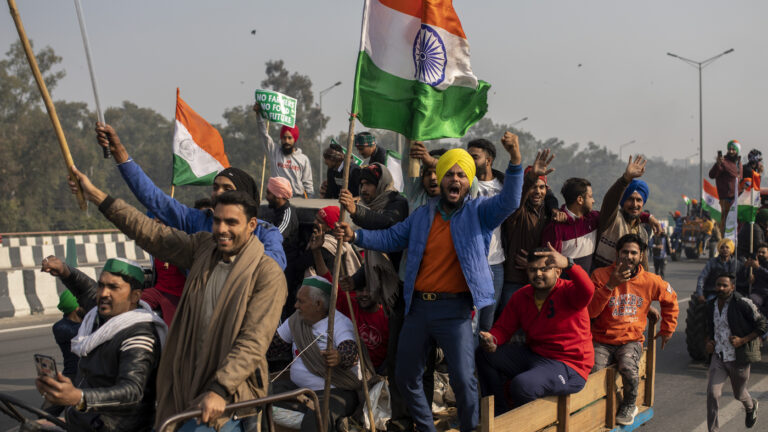
Tensions escalated in northern India as police deployed tear gas to thwart thousands of farmers demanding minimum crop prices from marching on Delhi. The capital, fortified with razor wire, cement blocks, and fencing on three sides, seeks to prevent a reoccurrence of the 2020 protests, where dozens lost their lives during a year-long demonstration that led to the repeal of controversial agriculture laws. However, over two years later, farmers claim that other promises made during the resolution have not been fulfilled.
India’s farmers wield significant political influence, forming a crucial voting bloc. Analysts suggest that Prime Minister Narendra Modi’s government, vying for a third consecutive term in the upcoming general elections, is keen on avoiding alienating this key demographic.
Recent images depict dense clouds of tear gas being used to disperse protesters near the city of Ambala, approximately 200 km (125 miles) north of Delhi. Earlier, tear gas was fired at the Shambhu border between Haryana and Punjab states. The farmers, predominantly from Punjab, express their peaceful intent to cross Haryana and reach Delhi, but authorities have restricted their movement. Reports of scuffles between police and protesters at the Shambhu border underline the tense situation.
The 2020 protests saw farmers enduring months of hardship, blocking national highways connecting Delhi to neighboring states. Widely regarded as a major challenge to Prime Minister Modi’s government, the movement eventually led to the repeal of the contentious agricultural laws.
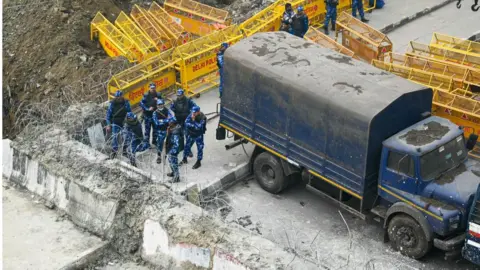
As the farmers’ protest intensified, disruptions and traffic jams plagued Delhi on Tuesday, with authorities implementing roadblocks and diverting traffic. Large gatherings were prohibited in the city, particularly at border points connecting Delhi to Uttar Pradesh and Haryana, the anticipated routes for the farmers.
In response to the escalating situation, the BJP-led state government in Haryana suspended internet services in seven districts until Tuesday. Despite two rounds of talks between farm union leaders and federal ministers, a resolution remains elusive.
Farmers are steadfast in their demands, seeking assured floor prices, also known as minimum support prices (MSP), which allow them to sell the majority of their produce at government-controlled wholesale markets or mandis. Additionally, they demand the fulfillment of the government’s commitment to doubling farmers’ income.
The latest meeting between federal ministers and farm union leaders, lasting six hours on Monday, resulted in partial agreement on certain demands, such as the withdrawal of cases against protesters from the 2020 demonstrations. However, a consensus on the MSP issue remains elusive. Although the government had pledged to establish a panel in 2021 to explore mechanisms for ensuring support prices for all agricultural produce after repealing the farm laws, the committee is yet to submit its report. The impasse further escalates tensions between the farmers and the government, setting the stage for continued protests and potential disruptions in the run-up to the general elections.
As the march gained momentum, Sarvan Singh Pandher, the general secretary of the Punjab Kisan Mazdoor Sangharsh Committee, emphasized the peaceful nature of the movement, stating, “We will move peacefully, and our objective is that the government listens to our demands.” With over 200 farmer unions participating, the collective strength of the protest amplifies the urgency for the government’s attention.
In a coordinated effort, farmers’ and trade unions have declared a rural strike scheduled for 16 February. During this strike, agricultural activities will come to a halt, and villages across the country will witness the closure of shops, markets, and offices. The farmers plan to block major roads, intensifying their demonstration against the government’s failure to address their demands, particularly the assurance of floor prices and the fulfillment of income doubling promises.
As the standoff between the farmers and the government continues, the resilience and unity of the agricultural community in India remain a significant force, and their actions are poised to impact the socio-political landscape leading up to the upcoming general elections.