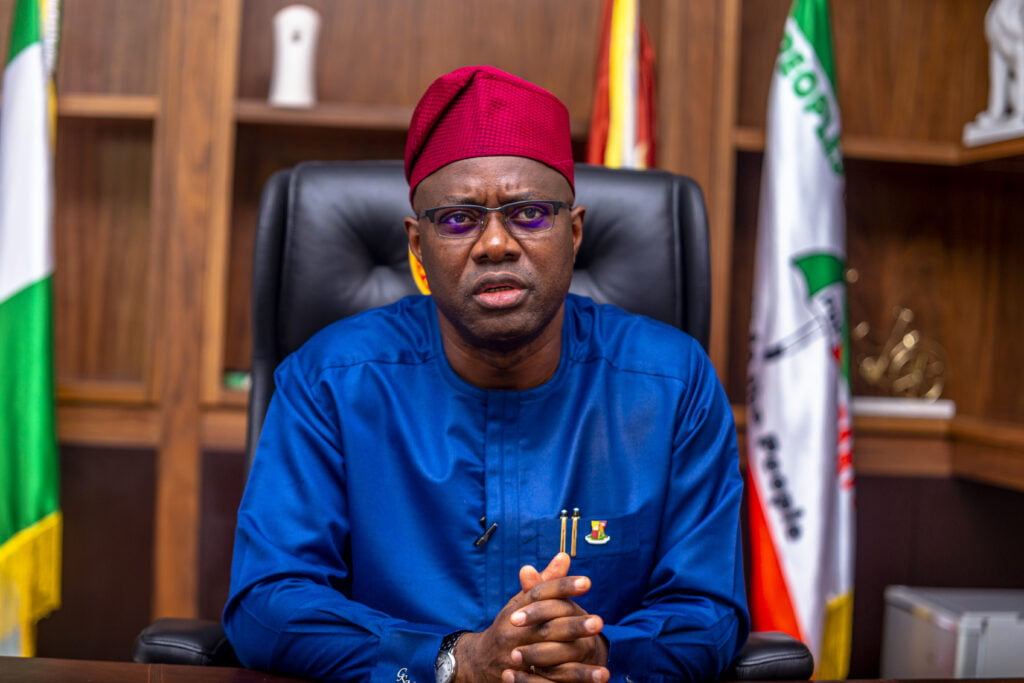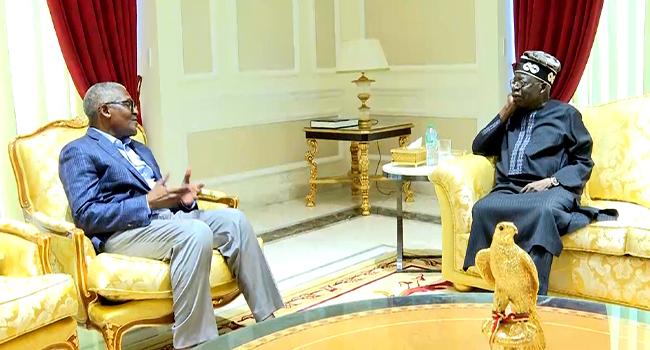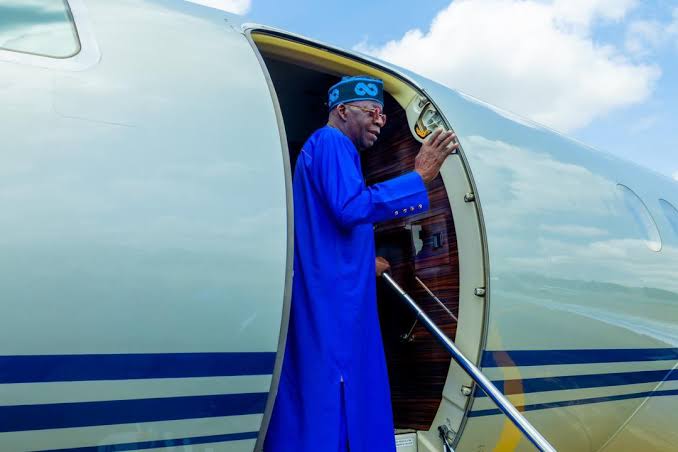
Two weeks after returning from a three-country visit that included London, Saudi Arabia, and Paris, the President-elect, Bola Tinubu, left Nigeria for Europe on Wednesday afternoon.
The trip is a part of Tinubu’s efforts to improve transition plans and programmes and to discuss with important aides about policy alternatives.
A statement from the Office of the President-elect, written by Tunde Rahman, claims that Tinubu can complete his work without undue stress or interruptions because of the trip.
In order to promote investment prospects in Nigeria and demonstrate his administration’s dedication to establishing a business-friendly environment through laws and regulations, Tinubu will meet with investors and important allies during the trip.
Meetings with multi-sectoral actors in Europe’s business community, including manufacturing, agriculture, tech, and energy, have been scheduled.
Tinubu hopes to convince them of Nigeria’s readiness for business under his leadership, focusing on job creation and skills acquisition.
Reviving the country’s economy is a major part of Tinubu’s Renewed Hope agenda, and the meetings aim to re-establish Nigeria’s importance in the global economic chain and create opportunities for the country’s youth population.
The statement reads, “He will use the opportunity of the trip to finetune the transition plans and programmes, and his policy options with some of his key aides without unnecessary pressures and distractions.
“During the visit, the President-elect will engage with investors and other key allies with the goal of marketing investment opportunities in the country and his administration’s readiness to enable a business-friendly climate through policies and regulations.
“Asíwájú Tinubu hopes to convince them of Nigeria’s readiness to do business under his leadership through mutually-beneficial partnerships premised on jobs creation and skills acquisition.
“Reviving the country’s economy forms a major plank of Tinubu’s Renewed Hope agenda and the meeting is part of his efforts to re-establish Nigeria’s importance in the global economic chain and create empowering opportunities for the country’s huge youth population.
“The President-elect has hitherto promised to hit the ground running and the visit is reflective of his commitment to the promise as he has already begun talks with global actors in the important areas of the economy and security.
“Before he left the country, Asíwájú Tinubu met with the House of Representatives candidates for Speaker and Deputy Speaker endorsed by his party, the All Progressives Congress, Hon. Tajudeen Abbas and Hon. Benjamin Kalu, who were presented to him by the Joint Task Team of the House.
“He is scheduled to return shortly for preparations towards his official swearing-in as the 16th President of the country on May 29, 2023.”
Meanwhile the Executive Chairman of the Revenue Mobilisation Allocation and Fiscal Commission (RMAFC), Mohammed Shehu, said on Wednesday that the monthly remuneration of the Nigerian President is N1.2 million and that of the governors is N1.1 million.
President-elect Bola Tinubu would be paid the same salary package if the proposed review of the Remuneration Act for elected and designated public officials is not enacted before President Muhammadu Buhari’s term expires on May 29.
Shehu claimed that no public servant should be paid more than the president or state governors after revealing that some heads of federal government agencies receive higher monthly pay.
He made these statements at the Economic Confidential public lecture and book presentation in Abuja, organized by Economic Confidential, Publishers of PR Nigeria, and Economy Digest.
The RMAFC Chairman said, “The salary of Mr President is N1.2 million a month. I’m sure some MDAs heads earn N5 million and some N2 million a month. No public servant in Nigeria should earn more than Mr President and the governor of a state.
“Elected National Assembly members earn N12 million and N8 million respectively. All those monies some people alluded to are not their salary.
“They have operational costs and other expenses added to it. These monies were put into it by the National Assembly as logistics and they are paid from the system.
“We don’t have the power to checkmate that. Only the Nigerian public can challenge that.”
Shehu further pointed out that the salaries of people who hold specified public and judicial offices, as well as political office holders, have not been reviewed since 2008, indicating that a review is long overdue.
Additionally, he said that the revenue from solid minerals is now divided, with states that produce solid minerals receiving a 13% derivation, just as states that produce oil.
Ada Peter