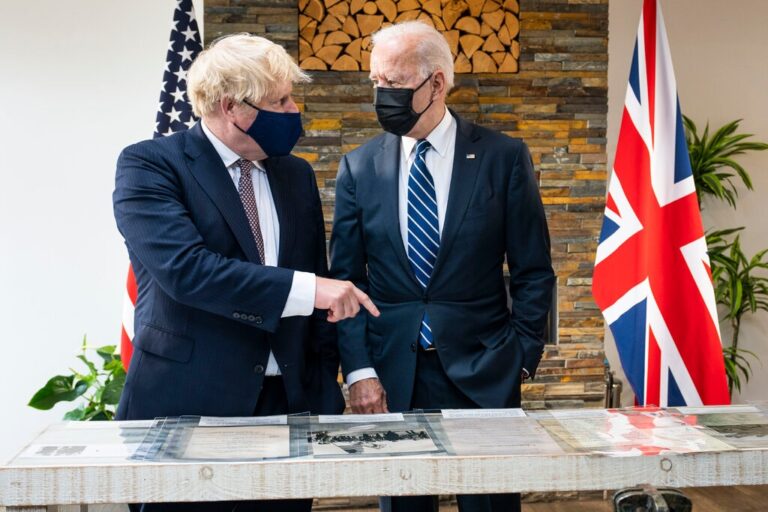
With the world confronting the immediate crisis of a pandemic and the long-term challenge of climate change, President Biden and Prime Minister Boris Johnson of Britain on Thursday turned for inspiration to another period of peril and deep uncertainty.
After meeting face to face for the first time since Mr. Biden assumed the presidency, they announced a renewal of the Atlantic Charter — the declaration of cooperation that Prime Minister Winston Churchill and President Franklin D. Roosevelt laid out during World War II.
While the two current stewards of the “special relationship” between Britain and the United States have disagreed on critical issues, on Thursday they stressed the enduring strength of the alliance.
When the original Atlantic Charter was signed on Aug. 14, 1941, the Nazis had conquered much of Europe, Britain stood largely alone and the United States had yet to join the war.
But the symbolic import of the Atlantic Charter declaration had been backed up by the passage of the Lend-Lease Act only a short time earlier, allowing the United States to provide critical military equipment to allies.
Before Mr. Biden and Mr. Johnson signed the new document, a senior United States official called it a “profound statement of purpose” that echoes the 80-year-old charter by underscoring the original declaration: that “the democratic model is the right and the just and the best” one for confronting the world’s challenges.
The official, who spoke to reporters on the condition of anonymity before the meeting between the two leaders, said the charter did not envision a new Cold War between great powers, but rather a world whose problems — including climate change, pandemics, technological warfare and economic competition — are complex and often nuanced.
However, at the core of the president’s message during the trip is a central animating theme: The United States and its allies are engaged in an existential struggle between democracy and autocracy.
“I believe we’re in an inflection point in world history,” Mr. Biden said on Wednesday evening in a speech to troops stationed at R.A.F. Mildenhall at the start of his European visit. “A moment where it falls to us to prove that democracies not just endure, but they will excel as we rise to seize enormous opportunities in the new age.”
In what he hopes will be a powerful demonstration that democracies — and not China or Russia — are capable of responding to the world’s crises, Mr. Biden announced that the United States would donate 500 million doses of the Pfizer-BioNTech Covid vaccine to 100 poorer nations, a program that officials said would cost $1.5 billion.
By playing a leading role in the effort to vaccinate the world and providing resources to confront the gravest public health challenges, officials said the United States was reclaiming a role it has sought to play since the end of World War II.Mr. Johnson, who is eager to use the summit as a showcase for a post-Brexit identity branded “Global Britain,” has also outlined ambitious plans to help end the pandemic. In the run up to the summit, Mr. Johnson called on leaders to commit to vaccinating every person in the world against the coronavirus by the end of 2022.
Yet while Mr. Johnson and Mr. Biden may find common ground on key issues including the pandemic, fundamental divisions remain.
Mr. Biden opposed Britain’s drive to leave the European Union, a push that Mr. Johnson helped lead. The American president is also concerned about Northern Ireland, since the Brexit deal has threatened to reignite sectarian tensions in the territory.
NYT