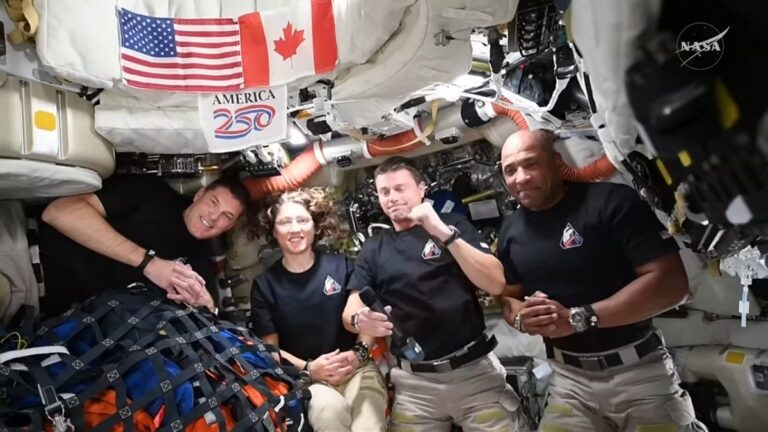
Four astronauts aboard Orion spacecraft safely returned to Earth on Friday, completing the first crewed lunar flyby in more than 50 years and marking a major milestone for NASA’s lunar exploration program.
The capsule splashed down off the coast of California after a successful re-entry through Earth’s atmosphere, ending a nearly 10-day mission that took the crew around the Moon and back.
Mission commander Reid Wiseman confirmed that all four astronauts were in good health after landing. The crew also included Christina Koch, Victor Glover, and Jeremy Hansen.
The mission tested key systems aboard Orion, especially its heat shield, as the spacecraft re-entered at speeds exceeding 30 times the speed of sound. NASA officials described the return as smooth and highly successful.
Artemis II launched from Florida on April 1 and became the first crewed mission in NASA’s Artemis program, which aims to return humans to the Moon and eventually establish a long-term lunar presence.
The astronauts also set a new distance record for human space travel, reaching more than 252,000 miles from Earth. Along the way, they captured thousands of images of the Moon and deep space, while also observing a solar eclipse and meteorite impacts on the lunar surface.
The mission carried historic significance: Glover became the first Black astronaut to orbit the Moon, Koch the first woman, and Hansen the first non-American to complete a lunar flyby.
NASA hopes the success of Artemis II will pave the way for a lunar landing mission by 2028 and support future plans for human missions to Mars.