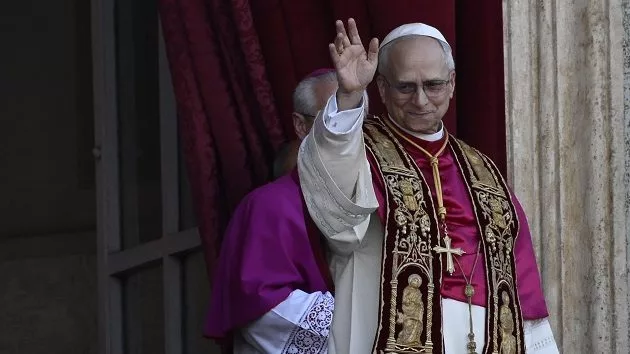
The Catholic Church has elected its first American pontiff: Cardinal Robert Prevost of Chicago has been chosen as the 267th pope, taking the name Pope Leo XIV, following the death of Pope Francis on April 21.
Prevost, 69, a seasoned diplomat within the Church and longtime servant in Latin America, emerged as a leading candidate in the days leading up to the conclave. His election was confirmed Thursday afternoon when white smoke rose from the Sistine Chapel and the bells of St. Peter’s Basilica rang out — a traditional signal that a new pope had been chosen.
Moments later, Pope Leo XIV appeared on the balcony of St. Peter’s Basilica to deliver his first address, invoking the memory of Pope Francis and pledging continuity with his predecessor’s pastoral mission.
“We must be a Church that builds bridges, not walls — a Church that welcomes with open arms, like this very piazza,” he said, addressing the crowd in Italian before giving the traditional Urbi et Orbi blessing.
A Papal Name with Historical Weight
By choosing the name Leo, Prevost aligns himself with a lineage of popes known for championing social justice and spiritual reform. Pope Leo XIII (1878–1903), in particular, is remembered for his foundational work in Catholic social teaching. Leo now becomes the 14th pope to bear that name — the fifth most popular in papal history.
A Career Spanning Continents
Ordained in 1982 after completing studies in canon law at Rome’s Pontifical University of Saint Thomas Aquinas, Prevost spent much of his ecclesiastical career in Peru as a missionary, teacher, and bishop. Pope Francis appointed him bishop of Chiclayo in 2014 and later tapped him for senior Vatican duties.
Since 2023, he has served as Prefect of the Dicastery for Bishops, overseeing global appointments of bishops — a role that gave him considerable influence in shaping the Church’s leadership. He also presided over the Pontifical Commission for Latin America.
A Pastoral Vision Rooted in Humility
In previous interviews, Pope Leo XIV emphasized the need for humility and closeness to the faithful in Church leadership. “A bishop is not supposed to be a little prince sitting in his kingdom,” he told Vatican News in 2024. “He must walk with the people and share their suffering.”
He has also advocated for synodality — a vision of the Church grounded in shared responsibility and collective discernment.
Reaction and Outlook
The Rev. James Martin, a papal commentator for ABC News, described Pope Leo as “down-to-earth and deeply pastoral.” He added, “This is someone who understands the global Church and lives its diversity.”
Pope Leo XIV now faces the monumental task of guiding 1.4 billion Catholics around the world through a time of internal reform and external challenge. His election represents not only a historic first for the American Church but also a nod to the increasingly global face of Catholicism.