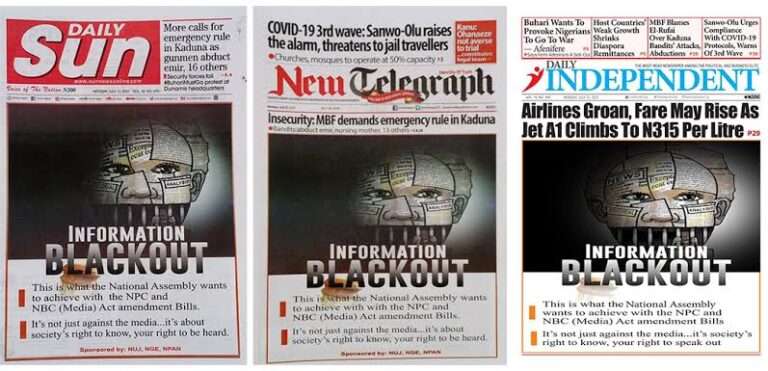
Another round of media fortitude, this time as publications in significant dailies in Nigeria, has followed Monday’s broadly coursed advertorial approaching the public authority to close down two dubious media bills at the National Assembly.
Nigerian papers communicated their hatred for the bills in their separate publications on Tuesday, saying, while the media isn’t loath to guidelines, it needs it managed without sabotaging its freedom.
This to a great extent clarifies why the Nigeria Press Council (NPC) and the National Broadcasting Commission (NBC) alteration bills have been subject of full-throated backlash particularly from media bunches who depicted the proposed enactments as an endeavor to smother the press.
The bills do not offer the independent regulatory possibility the press said it was open to, the newspapers said in their editorials.
Rather, it serves into the hands of the government – which has a history of arbitrarily censoring and fining broadcast media that air programs it disagrees with – by handing sweeping prosecutorial powers to the president and the minister of information.
The Nigerian Press Council (NPC) bill for one gives the president the power to appoint the chairman of the council’s board as well as other members of the board upon the recommendation of the information minister.
Likewise, the executive has sought the National Assembly’s cooperation to empower the National Broadcasting Commission (NBC), through its amendment bill, to wield regulatory powers over “all online media” as it already does with broadcast media.
The National Assembly has said the bills would “remove bottlenecks affecting (media) performance and make it in tune with current realities in regulating the press.”
The spokesperson of the Senate called the advertorial against the bills a blanket media ambush. House Speaker Femi Gbajabiamila has also said the legislation was proposed in good faith.
“We cannot let every institution run amok, the executive is regulated, the judiciary to a large extent is regulated, the legislature is regulated,” Mr. Gbajabiamila said. “Institutions are meant to be regulated, there is no one institution that is above the law.”
The proposed amendment to section 2 of the NBC would continue to make the NBC the accuser, the prosecutor, and the judge in its case.
But Guardian Newspaper said it was curious to know why “an unelected body” such as NBC should be conferred with “the power to determine the public interest.”
“The media is not averse to regulations and sanctions against fake news and hate speech,” the newspaper added, “as long as they do not erode media independence and do not seek to criminalize journalism or undermine constitutional guarantees of freedom of expression.”
It said it believed that doing otherwise would roll Nigeria back “to the obnoxious military era of the 1980s” which will ultimately force “our democracy into darkness.”
“The international trend, which Nigeria should emulate, is in the direction of peer regulation and constitutionally guaranteed freedom of the press. The trend also includes removing from the statute all laws that criminalize freedom of expression.”
Vanguard Newspaper argued that the proposed “satanic…toxic” laws “have no redeeming features” as the sweeping power it gives the executive would “create a monster Minister of Information with the media as his footstool.”
Punch Newspaper saw the laws in no different light because they would “pave the way for the government to seize control of the media space and subjugate the free flow of information to the whims and direction of the state and its officials.”
It described the enablers within the parliament as persons with an anti-democratic and dictatorial identity who seek to “asphyxiate freedom of the press and erode the fundamental rights of Nigerians to free expression.”
The newspapers urged the proponents of the bills to acquaint themselves with Nigeria’s turbulent political history and the roles of the press right from the colonial era through to the military era and the eventual actualization of democracy.
They charged the National Assembly and the Executive to withdraw on their proposed clampdown on free discourse and restriction of the press, adding that the press can’t be curbed without a majority rule government losing its authenticity.
In the interim, it seemed the backer of the bills, Segun Odebunmi, has clasped under media tension requesting the bills to be suppressed as he disclosed to Channels TV’s Sunrise Daily on Tuesday that the House board watching out for the bills has “suspended it for more discussion to occur.”
Ada Peter