Iran has sharply rejected President Donald Trump’s suggestion that the Strait of Hormuz could be declared U.S. territory, insisting that Tehran will maintain its blockade of the strategic waterway until Washington changes course.
Iranian Deputy Foreign Minister Kazem Gharibabadi said Saturday that the strait, a crucial route for global energy supplies, could not be seized through political declarations or military force.
“This strait will only be opened and closed under Iran’s command,” Gharibabadi said, calling on the United States to “accept the reality of defeat and stop indulging in delusions.”
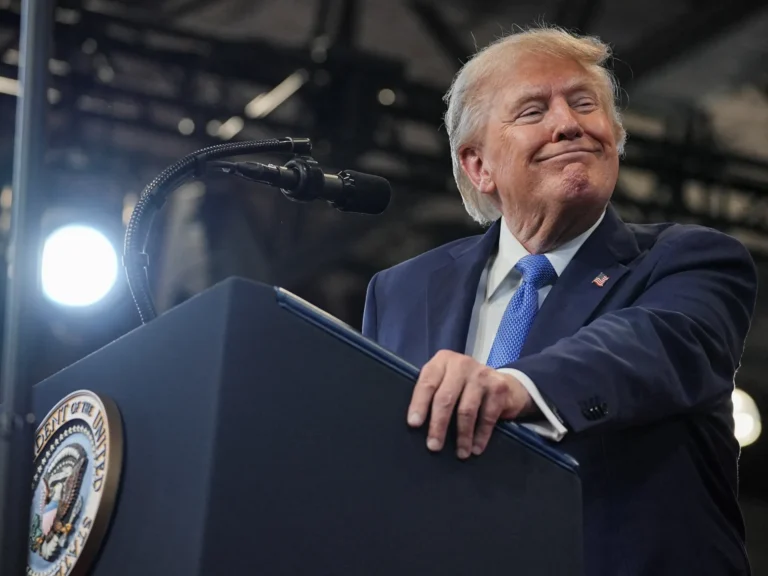
His comments came after Trump told an audience at a police academy in Nassau County, New York, on Friday that Iran was being “very badly defeated” and suggested he could soon declare the Strait of Hormuz a U.S. territory.
The escalating rhetoric comes as negotiations aimed at ending the conflict remain stalled. A 60-day negotiating period established under a memorandum of understanding signed by Washington and Tehran in June is due to expire Monday, with little progress reported.
Iranian Foreign Minister Abbas Araghchi said Friday that no negotiations were currently taking place between Tehran and Washington. He said Qatar and Pakistan were continuing to exchange messages as mediators but stressed that those contacts did not amount to formal negotiations.
Shipping through the Strait of Hormuz also remains severely restricted. Before the conflict, roughly 130 to 140 vessels typically passed through the waterway each day. Ship-tracking firm Kpler reported that only two vessels crossed on Friday, with no visible crude oil shipments.
Maritime security concerns intensified after the United Kingdom Maritime Trade Operations said a bulk carrier was struck in the hull by an unidentified projectile in the strait on Friday. The crew was reported safe, although the extent of the damage and any environmental impact remained unclear.
The continuing disruption has kept pressure on global energy markets. Oil prices, while below the sharp peaks recorded earlier in the conflict, remain significantly higher than before the war. Crude futures rose again Friday, while benchmark Brent was heading for a weekly gain of about 6%.
Vice President JD Vance said Thursday that Washington’s top objective was to keep oil and gas prices affordable for Americans, while preventing Iran from obtaining a nuclear weapon remained another major priority.
Tehran has repeatedly maintained that its nuclear program is not intended to produce nuclear weapons.
With shipping severely restricted, diplomatic efforts stalled and both Washington and Tehran exchanging increasingly confrontational statements, there are few indications that the conflict that began on February 28 is approaching a resolution.