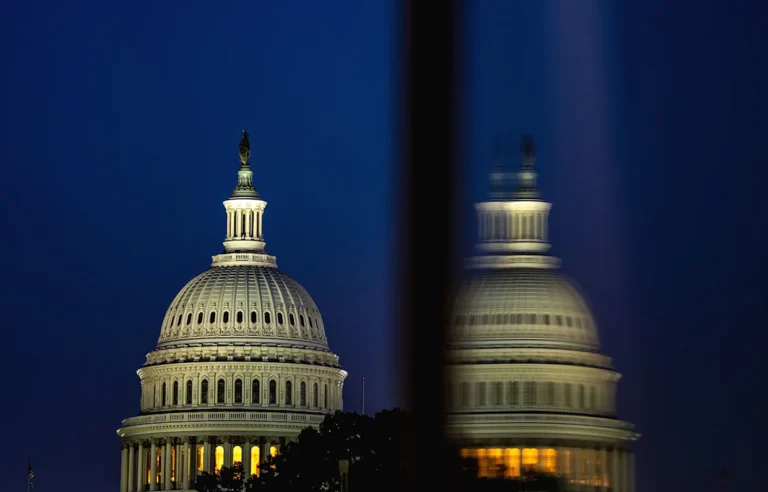
After 40 days of the longest government shutdown in U.S. history, the Senate on Sunday night narrowly advanced a bipartisan plan that could pave the way toward reopening the federal government.
The procedural vote passed 60–40, just clearing the threshold needed to move the measure forward. Applause broke out in the chamber as the vote was gaveled down at 10:49 p.m. ET.
Five Democratic senators — Tim Kaine, Dick Durbin, Maggie Hassan, Jeanne Shaheen, and Jacky Rosen — crossed party lines to support the measure, joining Democrats Catherine Cortez Masto, John Fetterman, and Independent Angus King, who have long favored advancing a funding bill. Sen. Rand Paul was the only Republican to oppose it.
The vote was seen as a key test of whether enough Democrats were willing to join Republicans to end the stalemate, even without securing an extension of Affordable Care Act (ACA) subsidies — a major sticking point throughout the shutdown.
According to multiple Senate sources, the proposal would extend government funding through January 31 and provide full-year appropriations for key agencies, including the Department of Agriculture — which funds SNAP benefits — and the Department of Veterans Affairs.
A senior Democrat said that there were “more than enough votes” to pass the measure, even though a majority of Democrats, including most party leaders, opposed it.
Under the agreement, Democrats would not receive immediate action on health care subsidies but would get a guaranteed Senate vote on extending ACA subsidies before year’s end — the same offer made by Senate Majority Leader John Thune over a month ago.
Although most Senate Democrats ultimately voted no, several sources said they were resigned to ending this phase of the standoff, with plans to renew the fight over health care in the 2026 midterm elections.
“Republicans refused to do anything for the millions of Americans who will see their health insurance premiums skyrocket,” one Democratic aide told ABC News.
The bill’s passage in the Senate does not immediately reopen the government. The House of Representatives, which has been out of session since September, must still return to Washington and vote on the measure before it can reach President Donald Trump’s desk.
The Senate also plans to make several key modifications before final passage, including:
- Extending the expiration date of the short-term funding bill from Nov. 21 to Jan. 31.
- Attaching three full-year appropriations bills covering Military Construction and Veterans Affairs, the Legislative Branch, and the Department of Agriculture, ensuring those programs remain funded through the fiscal year even if another deadline is missed.
- Potentially adding language guaranteeing a future vote on health care subsidies and reversing some workforce reductions implemented during the shutdown.
With this procedural victory, senators will now begin full debate on the measure — a crucial step toward reopening the government and stabilizing critical services as millions of Americans feel the mounting effects of the prolonged shutdown.