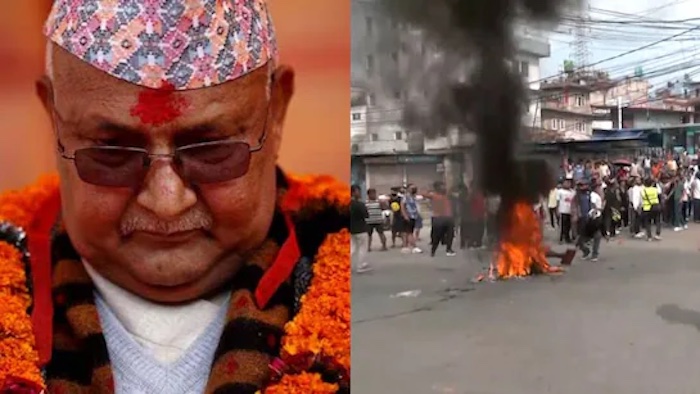
In a stunning political collapse, Nepalese Prime Minister KP Sharma Oli resigned on Tuesday following two days of massive anti-government protests that have left at least 19 people dead and much of Kathmandu in chaos.
The resignation came less than 24 hours after security forces opened fire on largely youthful demonstrators, marking one of the bloodiest crackdowns in the country since the end of the monarchy in 2008. Protesters, enraged by deep-rooted corruption, rising inequality, and the recent ban on social media platforms like WhatsApp and Instagram, defied a government-imposed curfew to confront state institutions head-on.
What began as a digital backlash over internet censorship quickly spiraled into nationwide civil unrest, culminating in the storming of the Singha Durbar—the prime minister’s official compound—on Tuesday afternoon. Protesters set it ablaze along with multiple police stations, government offices, and residences of top political leaders.
Despite a heavy deployment of riot police and military units, security forces were unable to contain the unrest, with videos circulating online showing officers retreating from advancing crowds.
The government’s move to lift the social media ban early Tuesday in a bid to defuse tensions appeared too little, too late. Instead, it emboldened more demonstrators to take to the streets.
Oli’s resignation, along with those of several senior lawmakers, has thrown the ruling coalition into disarray and left a political vacuum at the heart of the Himalayan republic. Opposition parties and civil society leaders are now demanding broad democratic reforms and accountability for the deaths of protestors.
“This is not just about internet freedom anymore. It’s about a broken system that no longer serves the people,” said Ramesh Koirala, a prominent protest leader, speaking from outside the charred ruins of a government building.
Nepal now faces one of its most uncertain periods in over a decade. With no clear successor and the ruling coalition fractured, analysts warn of a prolonged power struggle and the risk of escalating unrest. International observers have called for restraint and dialogue, urging the government to investigate the use of lethal force and engage protestors in meaningful political reform.