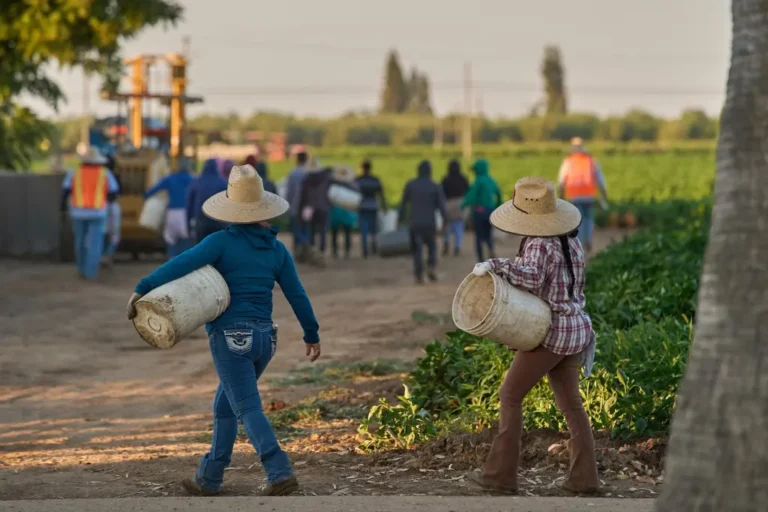
As tomato season peaks in California’s Central Valley, Lidia, a longtime farmworker, is busy in the fields—but she’s also on edge. More than two decades after crossing the U.S.-Mexico border without documentation, she fears the growing reach of immigration enforcement could abruptly end the life she’s built.
“The worry is they’ll pull you over while driving and ask for your papers,” said Lidia, who spoke to the Associated Press under the condition that only her first name be used due to fears of deportation. “We need to work. We need to feed our families and pay our rent.”
Her anxiety mirrors that of thousands of undocumented workers across the country, especially during this year’s Labor Day celebrations, which honor the contributions of workers in America. Experts warn that the Trump administration’s intensified immigration crackdown is having ripple effects across the labor market.
Preliminary data from the U.S. Census Bureau, analyzed by the Pew Research Center, reveals that more than 1.2 million immigrants—both documented and undocumented—exited the labor force between January and July. That decline comes as the U.S. immigrant population experiences its first downturn in decades, following a record 14 million undocumented individuals residing in the country in 2023.
According to Stephanie Kramer, a senior researcher at Pew, immigrants comprise nearly 20% of the U.S. workforce, and their contributions are particularly pronounced in agriculture, construction, and service sectors. “Roughly 45% of workers in farming, fishing, and forestry are immigrants,” she said. “They also represent 30% of construction jobs and 24% of service roles.”
While it’s still unclear how much of the decline is due to deportations, voluntary departures, or underreporting, Pew researchers say the downward trend is real. “Even with some statistical noise, we believe the drop reflects a genuine shift,” Kramer noted.
President Donald Trump has pledged mass deportations, claiming a focus on “dangerous criminals.” However, data shows that the majority of Immigration and Customs Enforcement (ICE) detainees have no criminal convictions. Meanwhile, illegal border crossings have sharply declined under his administration’s enforcement policies.
This shrinking labor force is already impacting American industries. “Immigrants typically account for at least half of U.S. job growth,” said Pia Orrenius, a labor economist with the Federal Reserve Bank of Dallas. “The border influx has essentially stopped—and that’s where millions of new workers were coming from.”
On the ground in McAllen, Texas, Elizabeth Rodriguez, a farmworker advocate, sees the consequences firsthand. With corn and cotton fields nearing harvest, she worries there won’t be enough workers for the machinery needed to process the crops.
“Immigration raids at farms, construction sites, and businesses bring everything to a halt,” said Rodriguez, who works with the National Farmworker Ministry. “In May, during peak watermelon and cantaloupe season, delays meant entire crops were wasted.”
Similar concerns echo in Ventura County, California, where Lisa Tate oversees her family’s citrus, avocado, and coffee farming operations on 800 acres. Amid an already challenging agricultural environment, labor shortages are compounding the pressure on growers.
As immigration enforcement tightens, farmworkers like Lidia and employers like Tate are grappling with the same uncertainty—how to keep the fields moving while navigating a changing and increasingly volatile labor landscape.