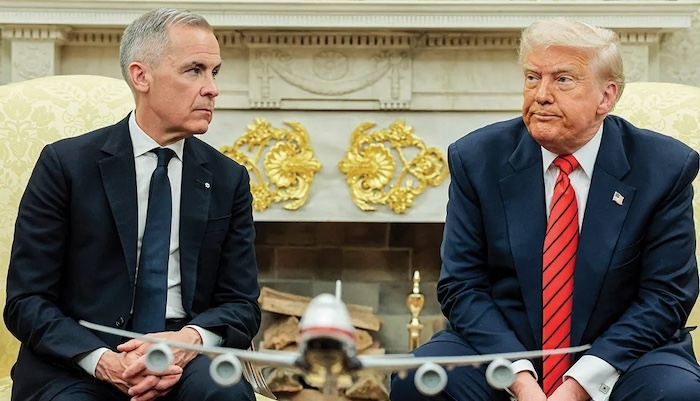
Canadian Prime Minister Mark Carney announced late Sunday that trade negotiations with the United States are back on track, just hours before a controversial 3% digital services tax targeting U.S. tech giants was set to take effect. The proposed tax—which would have applied retroactively to revenues earned by companies like Amazon, Meta, Google, and Airbnb—was expected to cost American firms roughly $2 billion in back payments by the end of June.
In a statement, Carney’s office said the decision to pause implementation was made “in anticipation” of renewed progress on a broader trade deal. The announcement followed a phone call between Carney and U.S. President Donald Trump earlier in the day. “Today’s announcement will support a resumption of negotiations toward the July 21, 2025, timeline set out at this month’s G7 Leaders’ Summit in Kananaskis,” Carney said.
The move marks a swift turnaround after Trump abruptly froze trade talks last week, calling Canada’s digital levy “a direct and blatant attack on our country.” His administration had threatened new tariffs in retaliation.
Canadian Finance Minister François-Philippe Champagne confirmed separate talks with U.S. Treasury Secretary Scott Bessent, stating that withdrawing the tax “will allow negotiations of a new economic and security relationship with the United States to make vital progress.”
The proposed tax, aimed at capturing revenue from digital services provided to Canadian users, had been championed by Ottawa as a matter of tax fairness. But it sparked fierce opposition from Washington and Silicon Valley, with critics warning it could ignite a damaging trade war.
“This is a clear concession,” said Daniel Béland, a political scientist at McGill University. “Trump forced Carney to retreat. It’s a win for the White House and for big tech.”
The rollback comes amid broader trade tensions. Trump, now in his second term, has already reinstated tariffs on Canadian steel, aluminum, and automobiles, and hinted at more penalties unless a new agreement is reached by the July deadline. His administration has also imposed targeted tariffs under anti-fentanyl policies, though certain goods remain protected under the existing USMCA agreement.
At the recent G7 summit, Trump quipped that Canada might “one day become a U.S. state”—a remark met with stiff unease in Ottawa.
For now, Canada’s digital tax is on hold, and negotiations are moving forward. But with a tight timeline and tariffs still looming, the path to a stable U.S.-Canada trade framework remains uncertain.