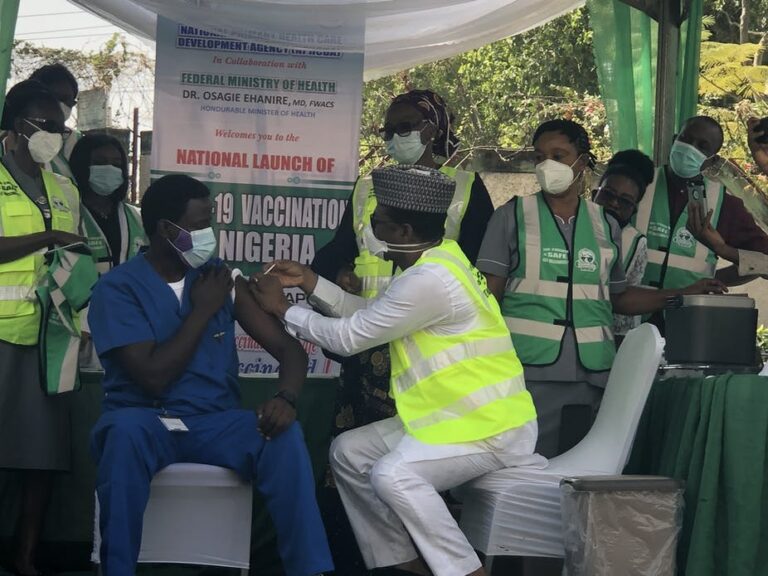
The Federal Government’s declaration last week that COVID-19 immunization will be required for civil personnel starting December 1, 2021, caught many Nigerians off guard. The announcement has elicited a range of reactions.
Dr. Monday Ubani, the Chairman of the Nigerian Bar Association Section on Public Interest and Development Law, NBA-SPIDEL, has threatened to take the federal government to court if it goes ahead with enforcing the directive.
However, according to Good Health Weekly, the federal government’s approach may not be as unusual as it appears.
Several countries have made COVID-19 vaccination mandatory for their workforce, while others have imposed other limitations on those who have not been vaccinated.
In Canada, government employees and all transport workers must be vaccinated against COVID-19, whereas in France, healthcare personnel must be vaccinated or face dismissal or suspension without pay.
Workers in the public and private sectors in Italy must have a green pass that shows proof of vaccination, a negative test result, or recent recovery from COVID-19.
After five days on leave, any employee who fails to submit a valid health certificate risks being fired without pay. Workers who go to work without being vaccinated face a fine of up to $2,000 if they are not vaccinated.
In the United States, all government employees and contractors must be vaccinated, and private businesses with 100 or more employees must compel employees to be vaccinated by December or undergo weekly testing. Violators may risk termination. Federal employees in Malaysia are required to be vaccinated by the end of October or face disciplinary action. COVID-19 immunizations are also required for teachers and healthcare personnel in New Zealand.
However, while some public health experts say although such policy cannot be proven scientifically it is necessary to protect more Nigerians from infection, others insist that such mandatory policy must take into consideration the World Health Organisation’s recommendation that it is always better if health interventions are accepted without coercion.
Civil servants should make themselves available for the vaccine —Prof Ujah
Also, in a chat, the National President of Nigeria Medical Association, Prof. Innocent Ujah said the policy will help to reduce the spread of the COVID-19 virus and improve the health-seeking behavior of Nigerians.
“We are in support of the policy introduced by the federal government because it will help to reduce the spread of the virus and improve health-seeking behaviors of Nigerians. What government needs to do going forward is to ensure the vaccine is available.
“My advice to civil servants is that they should make themselves available for the vaccine. Nothing negative about the vaccine, I took my own a long time ago and am still healthy and strong. I also believe that enforcement won’t be a problem because workers are under different agencies with heads that will ensure enforcement for the benefit of all.”
Ujah disclosed that vaccine hesitancy is not a new thing as it happened during polio, “but we need to understand that the eventual acceptability of the vaccine and immunization take us out of polio pandemic country.
Dr. Godiya Ishaya reaction to the policy
In response to the policy, Dr. Godiya Ishaya, President of the National Association of Resident Doctors, NARD, stated the Federal government should study the World Health Organization’s (WHO) recommendations before implementing such policy.
WHO, he claims, believes that health interventions should always be accepted without force. “This is accomplished by strong public education, which is now lacking in the case of the COVID-19 vaccination, allowing individuals to freely buy-in.” The WHO then states that if it is to be mandatory, it must meet certain conditions.
“Firstly, it has to be safe and effective. So far the vaccine is safe, however, is it effective? What local studies have been done to show that it is more effective than the other measures already used like a facemask, hand washing, and social distances? More so, that people still come down with the illness even after vaccination. These are questions to answer.
“Secondly, the vaccine must be available everywhere. This is another issue.
Thirdly, it should be targeted at those at risk. For instance, health workers and civil servants, the countries that have made this vaccine compulsory made it so for specific groups only. Already, the vaccine is not recommended for children, pregnant and nursing mothers. Those are already out of it.”
He said the decision-making should be ethical even as it is compulsory, people should not be forced to take it.
“Also, the WHO said there should be a public trust. This is an issue in Nigeria. There is hardly any trust between the citizens and the government enough for people to entrust their health into the hands of the government and believe that the government has their best interest. These are the issues that need to be considered before making the vaccination compulsory. Voluntary vaccination remains the best and ideal means,” he concluded.
He went on to say that COVID-19 is a major public health concern because of the harm it has caused in terms of global health, economics, and security and that vaccines are one of the preventive measures that have been used in Nigeria, as well as other countries across the world.
It is up to the lawyers to decide if this is a violation of human rights in court, but we do have public health legislation that addresses this. If some people have taken the government to court, we should wait to see how those cases turn out before drawing any conclusions.
Ada Peter