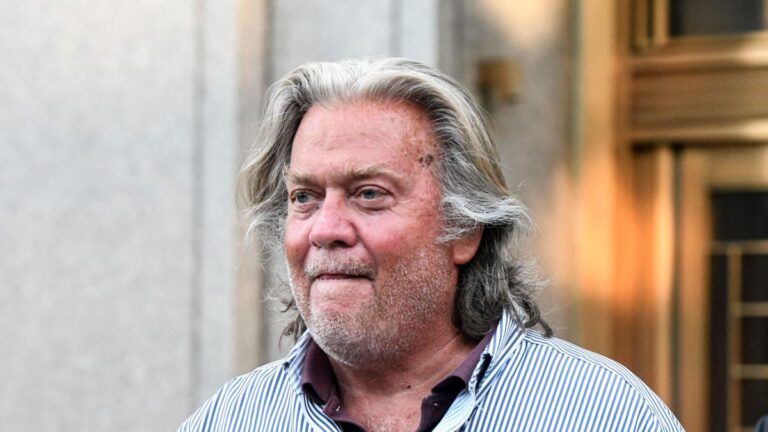
The House committee investigating the January 6 US Capitol attack is expected to formally kick off the process to hold Steve Bannon, one of former President Donald Trump’s closest allies, in contempt of Congress on Tuesday night when the panel is scheduled to meet and advance a referral to the Justice Department.
The measure is expected to move to a floor vote without any opposition from the committee members and marks a critical milestone in the investigation as the panel hopes even the remote threat of jail time inspires more Trump-aligned witnesses to cooperate.
In Tuesday’s meeting, the committee will adopt a contempt report, which was released Monday night and outlines the efforts the committee made to get a witness to comply with the subpoena, and the failure by the witness to do so.
This report is then referred to the House for a vote. If the vote succeeds, House Speaker Nancy Pelosi certifies the report to the United States attorney for the District of Columbia. Under law, this certification then requires the United States attorney to “bring the matter before the grand jury for its action,” but the Justice Department will also make its own determinations for prosecution.
Any individual who is found liable for contempt of Congress is then guilty of a crime that may result in a fine and between one and 12 months imprisonment. But this process is rarely invoked and rarely leads to jail time.
As severe as a criminal contempt referral sounds, the House’s choice to use the Justice Department may be more of a warning shot than a solution. Holding Bannon in criminal contempt through a prosecution could take years, and historically, criminal contempt cases have been derailed by appeals and acquittals.
The committee sent a letter to Bannon on Friday rejecting his argument for failing to comply with its subpoena and dismissing his claim of executive privilege, particularly as it relates to his communications with individuals other than Trump, according to a copy obtained by CNN.
Bannon has previously argued that he is unable to cooperate with the committee until matters of executive privilege are resolved by the courts, but Friday’s response makes clear the panel believes his “willful refusal to comply with the Subpoena constitutes a violation of federal law.”
“As was explained in the Select Committee’s October 8, 2021 letter … the former President has not communicated any such assertion of privilege, whether formally or informally, to the Select Committee. Moreover, we believe that any such assertion of privilege — should it be made by the former President — will not prevent the Select Committee from lawfully obtaining the information it seeks,” the letter says.
And even if the committee was “inclined to accept the unsupported premise” that executive privilege reaches communications between Bannon and Trump, the letter notes that Bannon “does not enjoy any form of absolute immunity from testifying or producing documents in response to a Congressional subpoena.”
CNN