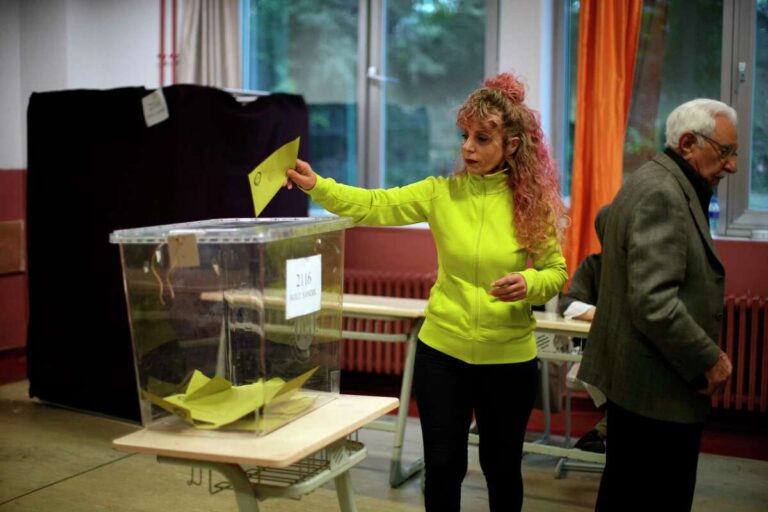
Voters in Turkey returned to the polls Sunday to decide whether the country’s longtime leader stretches his increasingly authoritarian rule into a third decade, or is unseated by a challenger who has promised to restore a more democratic society.
President Recep Tayyip Erdogan, who has been at Turkey’s helm for 20 years, is favored to win a new five-year term in the second-round runoff, after coming just short of an outright victory in the first round on May 14.
The divisive populist finished four percentage points ahead of Kemal Kilicdaroglu, the candidate of a six-party alliance and leader of Turkey’s center-left main opposition party. Erdogan’s performance came despite crippling inflation and the effects of a devastating earthquake three months ago.
Speaking to reporters after casting his vote at a school in Istanbul, Erdogan noted that it’s the first presidential runoff election in Turkey’s history. He also praised the high voter turnout in the first round and said he expected participation to be high again on Sunday.
“I pray to God, that it (the election) will be beneficial for our country and nation,” he said.
Kilicdaroglu (pronounced KEH-lich-DAHR-OH-loo), a 74-year-old former bureaucrat, has described the runoff as a referendum on the country’s future.
“This election took place under very difficult circumstances, there was all sorts of slander and defamation,” Kilcdaroglu told reporters after casting his ballot. “But I trust in the common sense of the people. Democracy will come, freedom will come, people will be able to wander the streets and freely criticize politicians.” He voted at the same time as Erdogan as local television showed the rivals casting ballots on split screens.
More than 64 million people are eligible to cast ballots. The polls opened at 8 a.m.
Turkey does not have exit polls, but the preliminary results are expected to come within hours of the polls closing at 5 p.m.
The final decision could have implications far beyond Ankara, because Turkey stands at the crossroads of Europe and Asia, and it plays a key role in NATO.
Erdogan turned his country from a mostly inward-looking nation into a geopolitical player with a foothold in hotspots such as Syria and Libya.
His government vetoed Sweden’s bid to join NATO and purchased Russian missile-defense systems, which prompted the United States to oust Turkey from a U.S.-led fighter-jet project. But under Erdogan, Turkey also helped broker a crucial deal that allowed Ukrainian grain shipments and averted a global food crisis.
The May 14 election saw 87% turnout, and strong participation is expected again Sunday, reflecting voters’ devotion to elections in a country where freedom of expression and assembly have been suppressed.
In the mainly-Kurdish populated province of Diyarbakir — one of 11 regions that was hit by the Feb. 6 earthquake — 60-year-old retiree Mustafa Yesil said he voted for “change.”
“I’m not happy at all with the way this country is going. Let me be clear, if this current administration continues, I don’t see good things for the future,” he said. “I see that it will end badly — this administration has to change.”
But Mehmet Yurttas, an Erdogan supporter, disagreed.
“I believe that our homeland is at the peak, in a very good condition,” the 57-year-old shop owner said. “Our country’s trajectory is very good and it will continue being good.”
If he wins, Erdogan, 69, could remain in power until 2028. After three stints as prime minister and two as president, Erdogan is already Turkey’s longest-serving leader. A devout Muslim, he heads the conservative and religious Justice and Development Party, or AKP.