The United States government has reaffirmed its commitment to strengthening bilateral ties with Nigeria to support the country’s ongoing fight against terrorism and banditry, while exploring new areas of military collaboration.
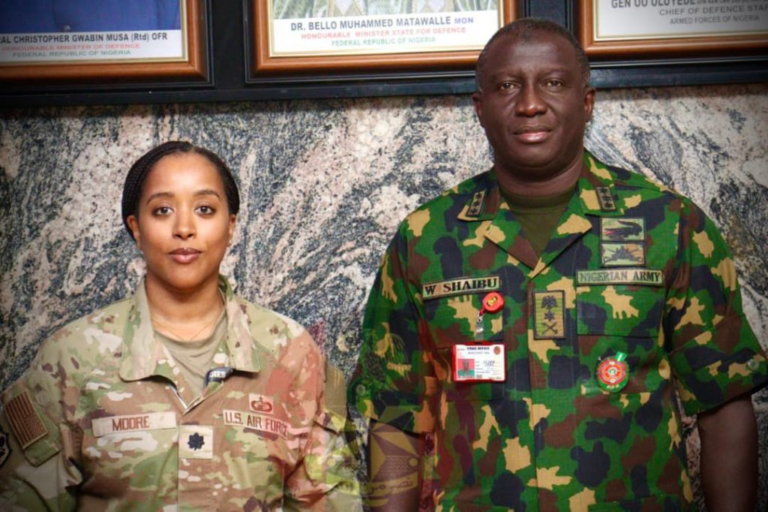
The assurance was given by the U.S. Defence Attaché to Nigeria, Lieutenant Colonel Semira Moore, during a courtesy visit to the Army Headquarters in Abuja.
Moore said the United States is keen on deepening cooperation with Nigeria, particularly in capacity building, intelligence sharing, and joint operational planning, to enhance counterterrorism and counterinsurgency efforts.
The renewed commitment comes two days after the U.S. delivered critical military supplies to Nigeria, aimed at supporting ongoing security operations across the country. The delivery was earlier announced by the United States Africa Command (AFRICOM) via its official X handle on Tuesday, describing it as a demonstration of the strong U.S.–Nigeria security partnership.
In a statement issued on Thursday by the Nigerian Army spokesperson, Colonel Apollonia Anele, Moore also reiterated the U.S. government’s support for the Nigerian Army in non-kinetic areas, including humanitarian assistance and troop welfare initiatives, which she described as critical to sustaining morale and operational effectiveness.
She expressed appreciation for the cordial and mutually beneficial relationship between both armies.
Responding, the Chief of Army Staff (COAS) commended the U.S. government for its enduring partnership and sustained support, noting that the Nigerian Army has benefitted immensely from American military professionalism and institutional expertise.
The COAS disclosed that he and several Principal Staff Officers of the Nigerian Army are alumni of renowned U.S. professional military institutions, describing this as a testament to the depth and impact of the bilateral military relationship.
He emphasized the Nigerian Army’s readiness to leverage the U.S. Army’s extensive experience in both kinetic and non-kinetic operations, while advocating for expanded cooperation to enhance operational effectiveness, institutional capacity, doctrine development, and strategic capability.