Peru plunged deeper into political upheaval early Friday as lawmakers unanimously voted to impeach President Dina Boluarte, citing “moral incapacity” amid a storm of corruption allegations and widespread public disapproval. In a swift transition, Congress President Jose Jeri was immediately sworn in as the country’s new head of state, becoming Peru’s seventh president since 2016.
The high-stakes impeachment vote, which unfolded just after midnight, followed hours of escalating tensions in Congress, where multiple political factions introduced motions accusing Boluarte of corruption and human rights violations stemming from her administration’s crackdown on anti-government protests.
In a national address from the presidential palace following her ouster, Boluarte acknowledged her removal by the same Congress that had elevated her to power in December 2022, following the failed self-coup attempt by her predecessor, Pedro Castillo.
“At every moment, I called for unity,” Boluarte, 63, said somberly. “But now, Congress has made its decision. This carries deep consequences for our democracy.”
Boluarte’s approval rating had recently sunk to historic lows — between 2% and 4%, as her government faced mounting accusations of corruption and abuse of power, including claims of illicit enrichment, undisclosed luxury assets, and a controversial salary increase.
Her failure to appear before lawmakers late Thursday night to defend herself sealed her fate, clearing the way for a rapid and decisive vote to remove her from office.
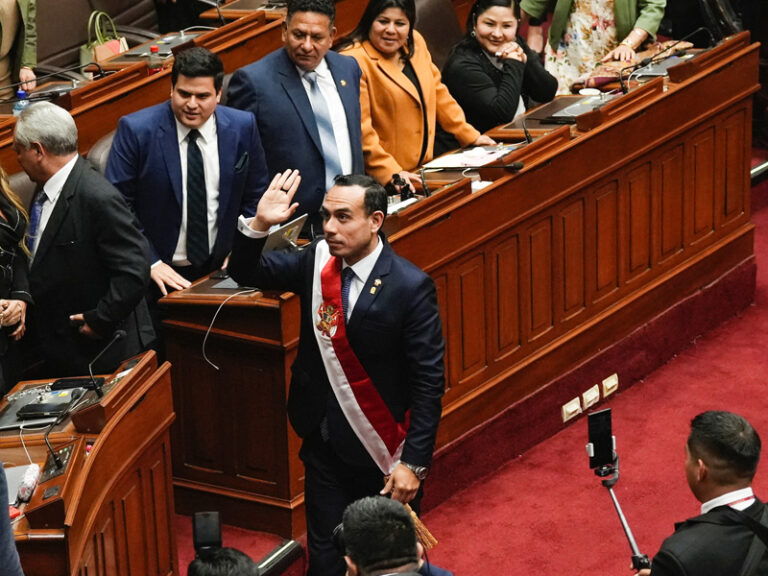
Immediately following the impeachment, Congress President Jose Jeri, 38, a lawmaker from the conservative Somos Peru party, took the presidential oath and donned the presidential sash.
In his first address to Congress, Jeri vowed to prioritize national security, one of the key issues cited by critics of the Boluarte administration.
“The main enemy is out there on the streets: criminal gangs,” Jeri declared. “We must declare war on crime and restore safety to our people.”
Outside the Congress building and the Ecuadorean embassy — where rumors swirled that Boluarte might seek asylum — crowds erupted in celebration, waving flags, dancing, and chanting in jubilation at her removal.
Boluarte’s ousting reflects a persistent pattern of political instability that has plagued Peru in recent years. Since 2016, the nation has seen a rapid succession of presidents, three of whom are now imprisoned, and countless corruption probes into sitting and former officials.
Although Congress had previously rejected several motions to impeach Boluarte, Thursday’s action gained momentum as former allies — including Popular Renewal and Popular Force, led by prominent right-wing figures Rafael López Aliaga and Keiko Fujimori — withdrew their support.
Her administration, already tarnished by accusations of violence against protesters, especially in Indigenous and rural Andean regions, came under renewed scrutiny in recent months over financial misconduct and the possession of luxury items, including Rolex watches not declared in official filings — allegations Boluarte has strongly denied.
As President Jeri assumes office, he faces the immense challenge of restoring public trust and stabilizing a volatile political landscape. His administration will be expected to address not only rampant crime but also economic discontent and calls for structural political reform.
Whether Jeri’s promises can bring calm to a disillusioned electorate remains to be seen. For now, Peru enters yet another chapter of political transition, with many citizens cautiously watching for signs of genuine change or yet another cycle of turmoil.