Over 50% of the cases were recorded among men, according to the most recent situation report from the Nigeria Centre for Disease Control (NCDC), which was published on Sunday.
The report also reveals that men made up 115 of the 172 cases reported between 1 January and 7 August, confirming the World Health Organization’s (WHO) assertion that the latest outbreak is disproportionately affecting men.
However, the NCDC isn’t as explicit as the WHO, which asserted that the infections are primarily among men who have sex with men, particularly in non-endemic countries.
WHO’s Technical Lead for Monkeypox, Rosamund Lewis said men who have sex with men are the group at the highest risk of infection right now, stating that about 99 percent of cases are among men, and at least 95 percent of those patients are men who have sex with men.
In July, WHO declared a global health emergency in response to the outbreak as cases rapidly increased.
According to the Centre for Disease Control and Prevention (CDC), 31,799 monkey cases have now been reported across 89 countries as of 12 August 2022.
NCDC situation report
In the latest situation report spanning 1 to 7 August, NCDC recorded 60 new suspected cases, adding that 15 were recorded from nine states and the FCT.
The breakdown of the cases shows that Imo State topped with three cases, followed by the FCT (2), Ondo (2), Rivers (2), Abia (1), Anambra (1), Ebonyi (1), Edo (1), Ogun (1) and Nasarawa (1)
Overall, since the re-emergence of monkeypox in September 2017, NCDC noted that 985 suspected cases have been reported from 35 states in the country and that 398 of the figure representing 40.4 percent were confirmed, (263 male, 135 female) from 30 states.
The disease control centre added that 12 deaths have been recorded since September 2017 in nine states: Lagos (3), Edo (2), Imo (1), Cross River (1), FCT (1), Rivers (1), Ondo (1) Delta (1) and Akwa Ibom (1).
It assured that “there are ongoing efforts to strengthen surveillance at National and sub-national levels, to increase awareness, and to promptly detect and respond to the outbreak.”

Monkeypox spread
Prior to the current outbreak, the majority of cases were found in endemic countries, but more recently, especially in non-endemic countries, the majority of cases have been found in gay, bisexual, or other men who have sex with men.
Although there is currently no proof that the virus is a sexually transmitted disease, the WHO has stated that anyone can contract it and that “human-to-human transmission can result from close contact with respiratory secretions, skin lesions of an infected person, or recently contaminated objects.”
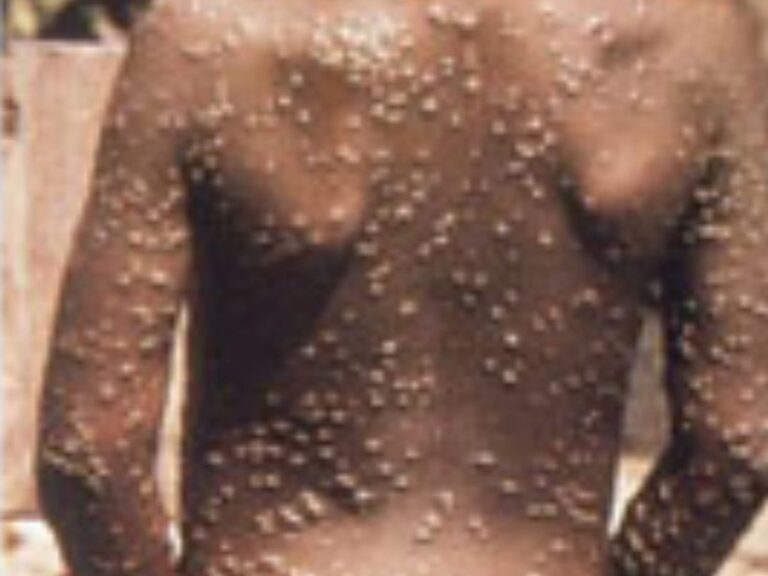
Monkeypox frequently causes swollen lymph nodes, fever, headache, exhaustion, and muscle aches.
The CDC advises against having intercourse with someone who has a rash that resembles monkeypox and suggests minimizing sex with many or anonymous people.