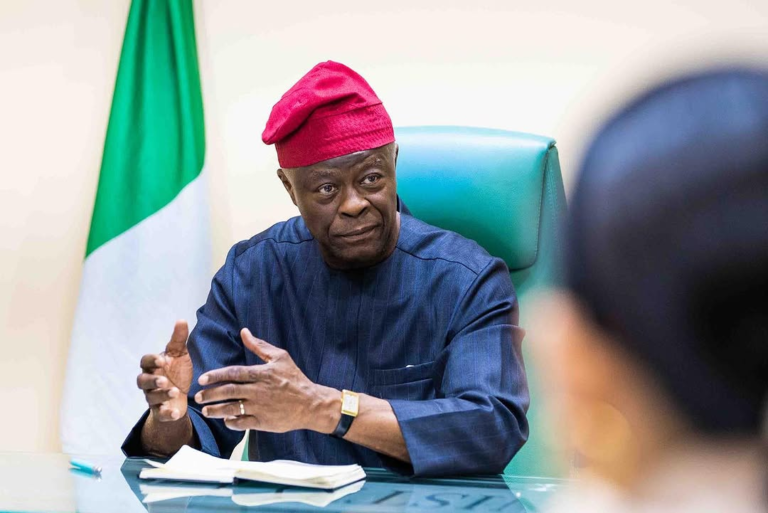
Nigeria has entered a phase of economic consolidation following two years of reforms that helped stabilise inflation, steady the exchange rate and rebuild investor confidence, the Minister of Finance and Coordinating Minister of the Economy, Mr Wale Edun, has said.
Edun gave the outlook while delivering the keynote address at the presentation of the Nigerian Economic Summit Group (NESG) 2026 Macroeconomic Outlook Report in Lagos yesterday. He said the country has recorded measurable macroeconomic stability after what he described as tough but necessary reforms.
According to him, the focus of economic policy has shifted from adjustment to consolidation, with emphasis on sustaining reforms already implemented and translating stability into growth that creates jobs and improves living standards.
Looking ahead to 2026, Edun projected stronger economic performance, with GDP growth expected to reach 4.68 per cent, inflation averaging 16.5 per cent, and the exchange rate stabilising around N1,400 to the dollar.
“Nigeria,” Edun stressed, “cannot afford to pause or retreat,” adding that “success in consolidation will determine whether stability becomes sustained growth and creates jobs.”
He said recent indicators show clear signs of improvement, noting that inflation has moderated, pressure in the foreign exchange market has eased, external reserves have strengthened and investor confidence is gradually returning.
Addressing concerns over the country’s rising debt profile, Edun explained that much of the N152 trillion public debt figure reflects improved transparency and exchange rate reforms rather than reckless borrowing. He said about N30 trillion represents previously unrecorded Ways and Means advances that have now been properly captured, while nearly N50 trillion resulted from the revaluation of foreign loans following exchange rate adjustments.
He added that Nigeria’s debt remains moderate relative to the size of the economy, noting that the debt-to-GDP ratio has declined to 36.1 per cent, which, in his words, “is among the lowest in Africa and far below the global average.”
Highlighting stronger macroeconomic indicators, Edun said inflation declined from 33.18 per cent in 2024 to 14.45 per cent by November 2025, while economic growth averaged 3.78 per cent by the third quarter of 2025, with 27 sectors, including manufacturing and agriculture, recording expansion.
He said external reserves rose to $45.5 billion, the exchange rate stabilised below N1,500 to the dollar, and Nigeria recorded a trade surplus of N19.33 trillion in the first nine months of 2025. Market capitalisation on the Nigerian Exchange, he added, also grew by almost 60 per cent year-on-year.
Despite revenue challenges, particularly in the oil and gas sector, Edun said the Federal Government maintained fiscal discipline in 2025, keeping the fiscal deficit at about 3.4 per cent of GDP, while non-oil revenue performance improved. He said allocations to states increased to strengthen fiscal federalism and support subnational governments, while capital budget implementation also improved, with about 84 per cent of 2024 capital projects executed during the transition period.
Edun said the 2026 budget, presented by President Bola Ahmed Tinubu, is designed as a Budget of Consolidation, Renewed Resilience and Shared Prosperity, with proposed total spending of N58.18 trillion. Of this, N26 trillion is allocated to capital expenditure, representing about 44 per cent of total spending.
He explained that the projected budget deficit of about four per cent of GDP is directly linked to Nigeria’s development needs, particularly investments in infrastructure and growth-supporting sectors.
Outlining key structural reforms planned for 2026, Edun said government revenue collection would be fully digitised, treasury operations made more transparent, and opaque deductions and leakages eliminated. He said new tax laws would protect low-income earners and small businesses, with essential food items and small enterprises exempted, while efforts would be intensified to fairly widen the tax base.
After two years of implementing what he described as transformative and politically difficult reforms, Edun said Nigeria is now at the threshold of stabilisation, which demands discipline and policy consistency.
“And that’s a big undertaking, and success here will determine whether stability is converted into sustained growth, whether growth delivers productive jobs, and whether poverty is reduced at scale,” he said.
“And of course, prosperity becomes shared prosperity, where millions are lifted out of poverty.”
Also speaking at the event, Chairman of NESG, Mr Olaniyi Yusuf, said the timing of the outlook was deliberate.
“This report is not intended as a forecast in isolation, but as a strategic lens through which to assess where the Nigerian economy stands today, how far we have come, and what the next phase of reforms must deliberately achieve,” he said.
Yusuf said Nigeria has just emerged from one of the most disruptive adjustment periods in its recent economic history, explaining that NESG frames the reform journey along a Stabilisation–Consolidation–
“These reforms were not painless, but they were unavoidable. They represented the stabilisation phase of our reform journey,” he said, noting that signals of stabilisation began to emerge in 2025, although structural weaknesses persist.
NESG Chief Executive Officer, Dr Tayo Aduloju, said the 2026 Macroeconomic Outlook provides an opportunity to consolidate recent gains and move decisively from crisis-era stabilisation towards a more durable and inclusive growth path.
“Growth remains below the level required for meaningful job creation and poverty reduction, fiscal pressures continue to constrain development spending, productivity in agriculture and manufacturing is subdued, and cost-of-living pressures remain elevated,” Aduloju said.
“These realities make consolidation not a pause in reform momentum, but a decisive push to solidify gains and accelerate transformation.”
He added that the report presents an evidence-based assessment of Nigeria’s macroeconomic conditions and underscores the need for credible macroeconomic anchoring, structural transformation, stronger institutions and deliberate investment in human capital and social protection, as Nigeria transitions from acute instability to a state of relative, though still fragile, macroeconomic stability.