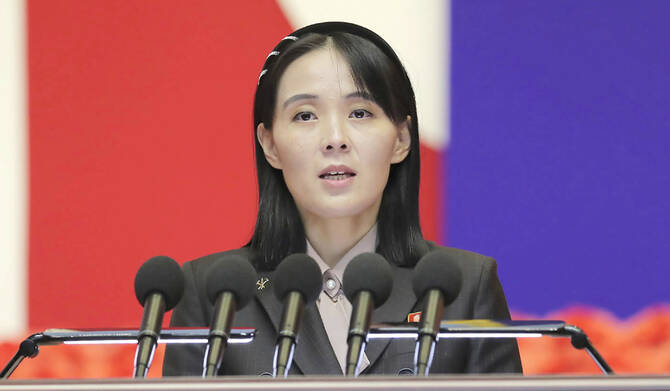
North Korean leader Kim Jong Un’s sister, Kim Yo Jong, has asserted that Pyongyang’s status as a nuclear weapons state is permanent and non-negotiable, warning that future diplomatic engagement with the United States must begin with that recognition.
In a statement published Tuesday by the state-run Korean Central News Agency (KCNA), Kim—who holds a senior position in the ruling Workers’ Party—dismissed any attempts to challenge the country’s nuclear status, calling it legally entrenched and supported by the “unanimous will” of the North Korean people.
“Any attempt to deny the position of the DPRK as a nuclear weapons state will be thoroughly rejected,” she said, referring to North Korea by its formal name, the Democratic People’s Republic of Korea.
Kim emphasized that a fundamental shift in Washington’s stance is essential if there is to be any progress in relations: “The U.S. should seek another way of contact on the basis of such new thinking.”
Her remarks come in response to a recent statement from a U.S. official, reported by South Korea’s Yonhap News Agency, indicating that President Donald Trump remains open to re-engaging with Kim Jong Un in pursuit of a fully denuclearized Korean Peninsula.
While Kim Yo Jong acknowledged the cordial rapport between her brother and Trump, she cautioned against any renewed attempts to leverage that relationship to revisit denuclearization discussions.
“To use their personal relationship as a tool for denuclearization efforts would be taken as mockery,” she said.
She also rebuffed recent overtures by South Korean President Lee Jae-myung, including the suspension of loudspeaker propaganda broadcasts along the border, calling them ineffective in restoring inter-Korean ties.
Since returning to the White House in January, President Trump has signaled an openness to restarting talks with North Korea. His earlier administration held three historic summits with Kim Jong Un between 2018 and 2019. Despite high-profile moments—including the first-ever meeting between U.S. and North Korean leaders—the talks failed to yield lasting agreements, and North Korea’s nuclear program has since advanced.
Last month, White House Press Secretary Karoline Leavitt said the administration was interested in building on the “progress” made in the 2018 Singapore summit, although no new policy roadmap has been publicly released.
Analysts view Kim Yo Jong’s remarks as a firm signal that Pyongyang is no longer interested in negotiating over denuclearization.
“This statement avoids mentioning Trump by name but clearly signals that the previous framework is obsolete,” said Jenny Town, director of the Korea Program at the Stimson Center in Washington. “Too much has changed since 2019 for talks to simply pick up where they left off.”
Observers say the comments reflect North Korea’s evolving diplomatic strategy—and a hardening position that complicates future engagement efforts.