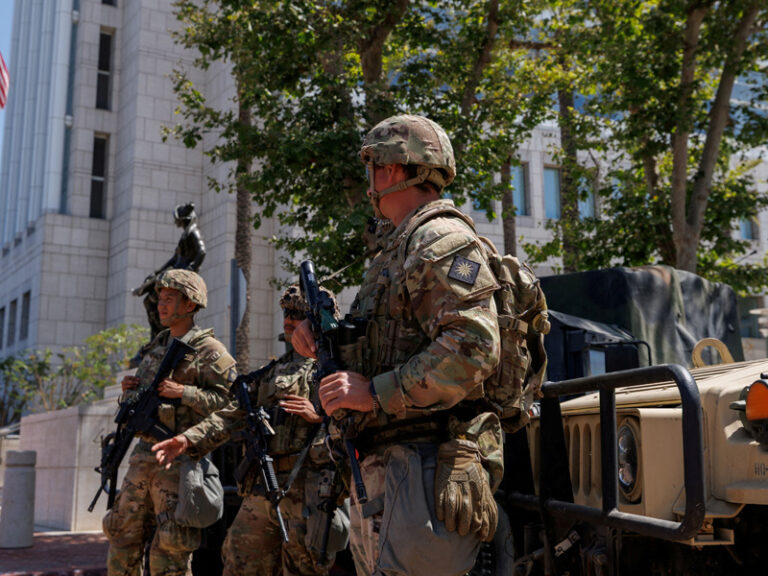
California officials told a federal judge Tuesday that President Donald Trump’s deployment of thousands of National Guard troops and Marines to Los Angeles last June was unlawful and should be halted immediately.
Speaking in San Francisco during the second day of a landmark trial, Meghan Strong of the California Attorney General’s Office said the troops’ actions breached the 19th-century Posse Comitatus Act (PCA), which forbids the military from engaging in civilian law enforcement.
“The government wanted a show of military force so great that any opposition to their agenda was silenced,” Strong argued.
The dispute stems from Trump’s order to send 4,000 National Guard troops and 700 Marines to Los Angeles after days of protests and unrest following mass immigration raids. Governor Gavin Newsom opposed the deployment and filed suit, claiming it crossed legal lines.
Justice Department lawyer Eric Hamilton countered that the violence justified military intervention, insisting the troops were there only to protect federal agents and property—an exception under the PCA. But California argues the troops went further, engaging in prohibited policing activities such as setting up roadblocks, diverting traffic, and making arrests. Government witnesses admitted such actions are generally barred but claimed they were permissible when defending federal assets.
U.S. District Judge Charles Breyer pressed Hamilton on whether the president has unchecked authority to determine when troops are necessary, asking if Trump’s declaration that protests were a “rebellion” was enough to justify deployment.
While many troops have since been withdrawn, Attorney General Rob Bonta said 300 National Guard members remain active, assisting in immigration raids and restricting civilian movement. The court will also hear arguments Wednesday on whether Newsom has standing to bring the case.
A ruling date has not been set, but the decision will not directly impact Trump’s separate plan to send National Guard units to Washington, D.C., to combat crime—a strategy he has suggested could be applied in other U.S. cities.