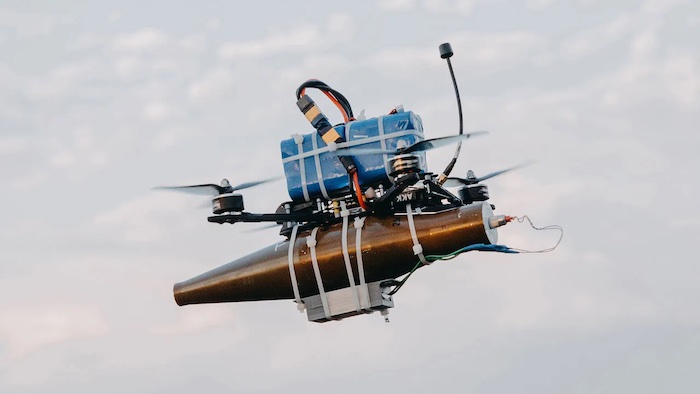
Ukrainian drone specialists have identified a highly advanced unmanned aerial vehicle (UAV) used in a recent Russian strike, raising serious concerns about the deepening military collaboration between Moscow and Tehran.
The drone, discovered among wreckage following a Russian attack, stood out from previously known models. Unlike Russia’s typical black drones, this UAV was painted white and bore English-language markings consistent with Iranian export standards. According to Ukrainian electronics expert Serhii Beskrestnov, known by his alias “Flash,” the internal design and labeling strongly indicate Iranian origin.
What has most alarmed analysts is the drone’s enhanced technology. It featured an onboard artificial intelligence platform, a remote-control system allowing it to be piloted from within Russia, and a newly identified Iranian-made anti-jamming system—marking a significant leap in drone warfare capabilities.
“This isn’t just another Shahed,” said Beskrestnov. “This appears to be a next-generation testbed for Iran’s military tech.”
Since late 2022, Russia has used Iranian-designed Shahed drones to strike Ukrainian targets, often deploying them in swarms to overwhelm air defences. Following a $1.7 billion arms agreement, Russia began domestic production of these drones at a secure facility in Tatarstan. The newly discovered drone appears to reflect ongoing upgrades to those systems.
Analysts noted that this latest model carries a more powerful warhead, upgraded cameras for precise targeting, AI-assisted navigation, and even thermobaric payloads capable of inflicting catastrophic damage to human tissue by collapsing lungs and eyeballs.
Particularly troubling is the drone’s anti-jamming capability. It carried eight antennas—twice the usual number—making it significantly harder to disable via electronic warfare.
Defence experts also noted that similar components have been identified in Iranian missiles used by Houthi rebels in Yemen, indicating a broader strategy by Tehran to field-test advanced weapons systems through allied proxy forces.
The discovery underscores growing international concern about Iran’s expanding role in Russia’s war on Ukraine, and the potential for further technology transfer that could reshape future conflicts.