A retired senior military officer has cautioned Nigerians against expecting United States troops recently deployed to the country to directly confront bandits and terrorists, insisting that the responsibility for ending insurgency rests squarely with Nigeria’s armed forces.
The former Director of Operations at the Army Headquarters, Major General Ijioma N. Ijioma (retd), gave the warning while reacting to the arrival of a small US military team sent to support Nigeria’s counterterrorism efforts.
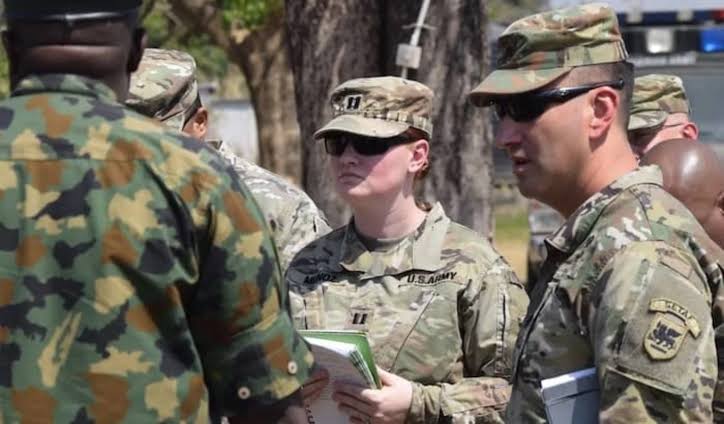
Last week, the United States confirmed the deployment of its personnel to Nigeria. The head of the US Africa Command (AFRICOM), General Dagvin R. M. Anderson, said the team was bringing “unique capabilities” as part of expanded collaboration between both countries to address terrorism. He, however, did not disclose the size or full scope of the mission, although indications suggest the troops will focus mainly on intelligence gathering and operational support.
Speaking on the development, Major General Ijioma said Nigerians should not be misled into thinking American soldiers would take over the battlefield.
“The US troops are not going to deploy on the battlefield to fight Nigeria’s war,” he said, stressing that their role would be limited to training, intelligence and technical assistance.
The retired general accused Nigeria’s political leadership of lacking the will to decisively tackle terrorism and banditry, arguing that insurgents have continued to thrive because they are handled with undue leniency.
According to him, if the Federal Government had approached the 1967 civil war with the same “kid gloves” being used against Boko Haram and bandits today, “there would have been a Biafra Republic by now.”
He questioned why terrorists appear emboldened despite recent foreign-assisted airstrikes on their camps, noting that Nigerian fighter jets are capable of reaching any part of the country.
“The strike the US carried out in Sokoto and Kwara — is there anywhere our fighter jets could not have bombed? There is no place within Nigeria that our aircraft cannot reach,” he said. “The reason they haven’t done the needful tells you clearly that what we lack is political will.”
Ijioma also expressed concern about the terms of Nigeria’s engagement with the United States, warning that Washington does not deploy troops without clear strategic interests.
“The United States does not risk the lives of its soldiers for nothing,” he said, urging Nigerians to demand transparency on the nature of the agreement between both countries.
He further contrasted Nigeria’s swift military intervention in Benin Republic during an attempted coup with the slow response to internal security threats.
“Our fighter jets went to Benin Republic. Our troops physically went there on the President’s order. What does that tell you? It tells you there is no political will,” he argued.
Recalling past military cooperation, the retired general said Nigeria had previously worked closely with the US during former President Olusegun Obasanjo’s administration, when American officers operated from the Defence Headquarters in Abuja.
“At that time, the third floor was out of bounds to Nigerian officers,” he recalled, adding that the arrangement was strongly opposed by the late Chief of Army Staff, General Victor Malu, and eventually led to his removal.
Also weighing in, a former Deputy Inspector General of Police, Goodwin Nwobodo (retd), said the success of the collaboration would depend on Nigeria’s sincerity and cooperation.
He warned that past mistrust, particularly around intelligence sharing, had hindered effective partnership with the US.
“If confidence exists this time, collaboration can work. But they can only assist us with technical know-how,” Nwobodo said.
He emphasized that US forces cannot operate independently in Nigeria without official consent, except in the case of a full-scale intervention, which he said would pose serious sovereignty concerns.
“According to international law, they are here to support Nigeria. They cannot operate without our consent,” he explained.
Security experts, however, expressed cautious optimism over the renewed partnership, urging the Federal Government to leverage American support to strengthen intelligence, technology and military capacity.
A former ECOMOG officer, Captain Effiong Eyo (retd), called on Nigeria to make “huge demands” for advanced military hardware and intelligence systems, arguing that technology remains key to defeating terrorism.
Others, including community leaders and conflict analysts, welcomed the collaboration but stressed the need for full disclosure, sustained political will, improved welfare for frontline troops, and access to modern weapons.
They warned that without decisive leadership and accountability, foreign assistance alone would not end Nigeria’s deepening security crisis, reiterating that the ultimate burden of defeating terrorism lies with the Nigerian state.