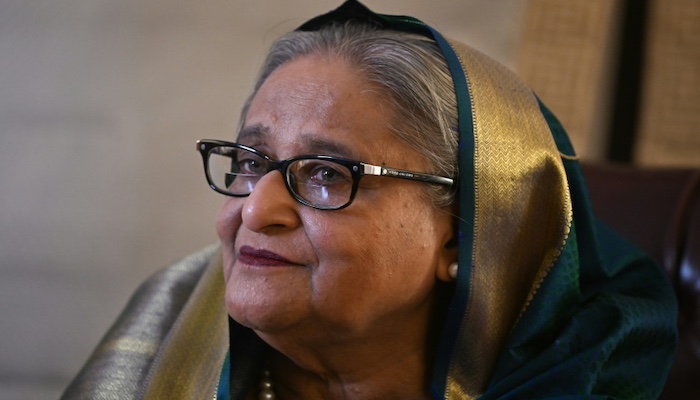
Prosecutors in Bangladesh have demanded the death penalty for former Prime Minister Sheikh Hasina, accusing her of crimes against humanity over a deadly military crackdown on student-led protests that brought down her government in August 2024.
Hasina, who ruled Bangladesh for 15 consecutive years, is being tried in absentia for allegedly ordering security forces to use lethal force against demonstrators during last year’s unrest. Prosecutors cited a leaked audio recording in which Hasina purportedly instructed commanders to “use lethal weapons” to suppress the protests — a claim she has vehemently denied.
Chief prosecutor Tajul Islam told the Dhaka Special Tribunal on Thursday that Hasina’s actions warranted “1,400 death sentences — one for each victim killed,” adding, “Since that is not humanly possible, we demand at least one.”
“Her sole aim was to cling to power indefinitely,” Islam said. “She became a hardened criminal who shows no remorse for the brutality she ordered.”
The protests erupted in July 2024 over controversial civil service job quotas favouring descendants of veterans from Bangladesh’s 1971 war of independence. The movement quickly grew into a nationwide uprising demanding Hasina’s resignation.
Over the following weeks, more than 1,400 people were killed, making it the bloodiest unrest in Bangladesh’s modern history. One of the deadliest incidents occurred on August 5, 2024, when Hasina fled her Dhaka residence by helicopter as crowds stormed the compound. Investigators say police opened fire on protesters that day, killing at least 52 people.
Hasina’s state-appointed defence lawyer argued that security forces acted in self-defence, claiming officers were attacked by violent mobs.
Hasina is being tried alongside former Interior Minister Asaduzzaman Khan Kamal and ex–police chief Chowdhury Abdullah Al-Mamun. Prosecutors have also sought the death penalty for Kamal, who remains in hiding.
Chowdhury, who pleaded guilty in July, admitted to carrying out government orders during the crackdown but has not yet been sentenced.
Hasina, 77, has already received a six-month prison sentence for contempt of court and faces multiple corruption charges stemming from her time in office. She is believed to be living in India, though New Delhi has neither confirmed nor denied her presence. Diplomatic sources say India faces mounting pressure to clarify her status.
The fall of Hasina’s once-dominant Awami League, now banned from political activity, has dramatically altered Bangladesh’s political map. Her longtime rival Khaleda Zia and the Bangladesh Nationalist Party (BNP) have emerged as frontrunners ahead of the February 2026 elections.
Observers say the outcome of Hasina’s trial could reshape Bangladesh’s political trajectory, warning that a verdict perceived as politically driven could further polarize the country.
International rights organisations, including Human Rights Watch and Amnesty International, have condemned both the 2024 crackdown and the ongoing trial, urging an independent investigation into the deaths of protesters and police officers.
Once hailed for transforming Bangladesh into one of Asia’s fastest-growing economies, Hasina’s legacy has been overshadowed by accusations of authoritarian rule, electoral manipulation, and suppression of dissent.
If convicted, she would become the first former leader in Bangladesh’s history to receive a death sentence while in exile — a ruling analysts warn could ignite fresh political turmoil in an already divided nation.