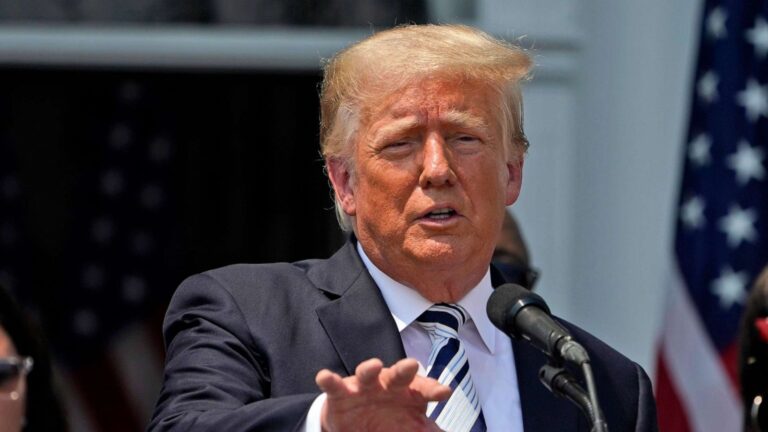
President Donald Trump intensified his global trade agenda on Tuesday, unveiling a 50% tariff on imported copper and outlining plans for steep new duties on semiconductors and pharmaceutical products. The announcement, delivered during a cabinet meeting at the White House, underscores the administration’s aggressive effort to “collect money” from nations Trump accuses of exploiting U.S. trade policies.
Trump also floated the possibility of a 200% tariff on imported drugs, though he acknowledged implementation could be delayed by up to a year.
“We’re finally standing up for ourselves,” Trump said. “Countries that were ripping us off are now going to pay their fair share.”
The copper tariffs, targeting a material vital to electric vehicles, defense systems, and infrastructure, are part of a broader expansion of duties that now affects a wide range of global imports. At least seven additional tariff notices are expected as early as Wednesday, targeting dozens of countries across sectors.
Markets responded with turbulence. Copper futures surged more than 10%, while pharmaceutical shares fell sharply on concerns over rising import costs and disruptions to supply chains.
The administration’s moves come despite ongoing trade negotiations with China, the European Union, and other partners. Although Trump described talks with Beijing and Brussels as “going well,” he warned that the EU should prepare for its own tariff announcement “within days.”
The U.S. has already imposed new 10% tariffs on goods from BRICS countries such as Brazil and India, and has threatened 25% duties on imports from allies like Japan and South Korea. Additional country-specific tariffs announced Tuesday include:
- 25% tariffs: Tunisia, Malaysia, Kazakhstan
- 30% tariffs: South Africa, Bosnia and Herzegovina
- 32% tariffs: Indonesia
- 35% tariffs: Serbia, Bangladesh
- 36% tariffs: Cambodia, Thailand
- 40% tariffs: Laos, Myanmar
While the administration had promised “90 trade deals in 90 days” when it launched the current tariff blitz in April, only two agreements—with the UK and Vietnam—have been finalized so far. A deal with India is reportedly near completion.
Despite stiff international pushback, Trump remains bullish. “The big money will start coming in on August 1,” he said, referring to the next round of across-the-board 10% tariffs and additional country-specific increases. Treasury Secretary Scott Bessent said tariff revenues have already topped $100 billion in 2025, with estimates projecting $300 billion by year’s end if current plans stay on course.
Global leaders are scrambling to respond. The EU, the U.S.’s largest trading partner, is offering trade concessions on sectors including aircraft and medical equipment, while pushing for protections for European automakers operating in the U.S.
“If we don’t reach a fair deal, we’re prepared to act,” warned German Finance Minister Lars Klingbeil, signaling potential retaliatory tariffs.
Japan and South Korea, both targeted with 25% duties, are accelerating negotiations in a bid to shield their key export sectors, particularly automobiles and electronics.
Meanwhile, Trump maintained an optimistic tone about China, referencing “constructive” talks with President Xi Jinping and a tentative trade framework agreed in June. Still, with an August 12 deadline looming, uncertainty hangs over whether a breakthrough deal can be achieved or if tensions will escalate.
Despite Trump’s confidence, economic experts warn the unpredictability and breadth of U.S. tariff policy is driving global market instability and putting strain on diplomatic relationships at a fragile moment for global recovery.
“The lack of clarity is compounding risks,” said trade economist Dana Redding. “If this continues, the long-term cost to both U.S. consumers and global economic confidence could be severe.”