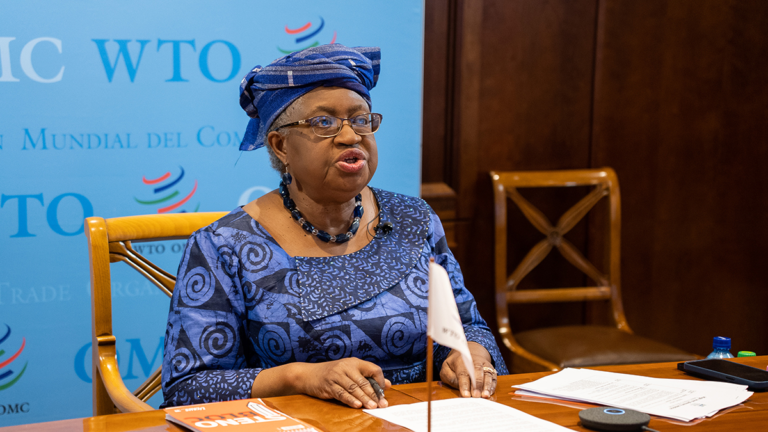
WTO Director-General, Ngozi Okonjo-Iweala, has warned that multilateral development banks (MDBs) alone lack the financial capacity to address the global climate crisis, urging a strategic shift toward greater private sector participation and subsidy redirection to fund climate action.
Speaking at the launch of the London School of Economics’ Global School of Sustainability on June 10, Okonjo-Iweala said the scale of funding required to tackle climate change is “in the trillions, not billions”, far beyond the capital resources of MDBs.
“We need billions, even trillions, to be able to fight this… it can’t be done by the MDBs alone,” she stated.
“They need to be better capitalised. They can’t raise even the hundreds of billions needed without additional capital from their shareholders.”
She urged governments to use MDBs as leverage points to unlock massive private finance, highlighting the need to “turn billions into trillions.”
The WTO chief also pointed to global subsidies, currently estimated at $2 trillion annually, as a missed opportunity to support climate efforts. These include:
· $1.2 trillion in direct fossil fuel subsidies
· $600 billion in trade-distorting agricultural subsidies
· $300 billion in inefficient water subsidies
· $22 billion in harmful fisheries subsidies
“Even if we just did half of that, and we channeled those resources to developing countries in the name of climate justice, wouldn’t we be doing something great?” she asked.
Citing Nigeria’s removal of fuel subsidies, Okonjo-Iweala applauded governments willing to take bold fiscal decisions in favour of sustainability and called on others to emulate such leadership.
Despite the growing severity of the climate crisis, she expressed concern over a global retreat in climate commitment from both governments and the private sector.
“Climate change is still seen as an environmental issue. It’s not seen as something that cuts across economics, finance, education, or health.”
She criticised the slow political response, stating that younger generations understand the urgency, but many leaders still fail to see climate change as an existential threat.
“There is a major part of the world where this is not now seen as a major problem. We are seeing retreat,” she warned.
“The fact that we are having this pulling back shows me that it is not as deep-seated as we would like.”
Okonjo-Iweala concluded by calling for a whole-of-government and multi-sectoral approach, urging world leaders to integrate climate action into the core of economic and policy decisions rather than treating it as a standalone environmental challenge.