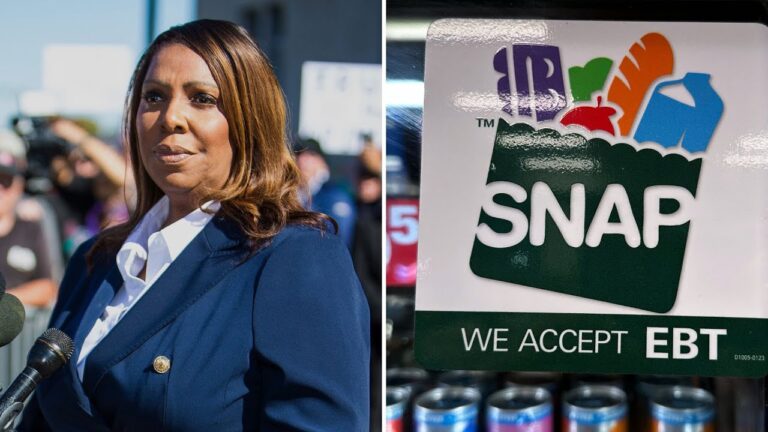
A coalition of 21 state attorneys general filed a lawsuit Wednesday against the U.S. Department of Agriculture, seeking to block new federal guidance that would bar certain immigrants—including refugees and individuals granted asylum—from receiving Supplemental Nutrition Assistance Program (SNAP) benefits.
The lawsuit, led by New York Attorney General Letitia James, argues that the Trump administration’s directive unlawfully strips tens of thousands of lawful permanent residents of access to food assistance.
“The federal government’s shameful quest to take food away from children and families continues,” James said. “USDA has no authority to arbitrarily cut entire groups of people out of the SNAP program, and no one should go hungry because of the circumstances of their arrival to this country.”
Attorneys general from Washington, D.C., and the states of Oregon, California, Colorado, Connecticut, Delaware, Hawaii, Illinois, Maine, Maryland, Massachusetts, Michigan, Minnesota, Nevada, New Jersey, New Mexico, North Carolina, Rhode Island, Vermont, Washington, and Wisconsin joined the lawsuit.
The legal challenge centers on USDA guidance issued October 31, which narrows eligibility for food stamps in line with restrictions set out in President Donald Trump’s domestic policy legislation passed earlier this year.
According to the attorneys general, the USDA memo exceeds what the law allows by making immigrants who entered the United States through humanitarian protection programs permanently ineligible for SNAP—even after they become lawful residents.
Under longstanding rules, several humanitarian immigrant groups are exempt from the five-year residency requirement that applies to most lawful permanent residents. The lawsuit argues that the USDA improperly excluded many of these groups from its updated eligibility list.
“The problem is that the Guidance lists some, but not all, of the conditions that render a lawful permanent resident immediately eligible for SNAP without a five-year waiting period,” the complaint states. “It omits key categories of Humanitarian Immigrant Groups, like Refugees and Individuals Granted Asylum.”
Other groups that qualify for immediate benefits but were left out of the USDA guidance include certain Afghan and Ukrainian parolees, Iraqi and Afghan Special Immigrant Visa (SIV) holders, and victims of severe trafficking.
The attorneys general warn that the new requirements—which call for rapid changes to state eligibility systems—could “destabilize SNAP nationwide” and saddle states with costly penalties for compliance failures.