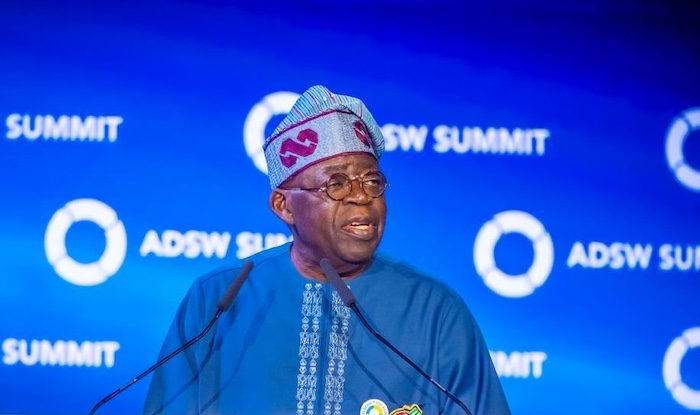
President Bola Ahmed Tinubu has described the Nigerian Exchange’s (NGX) crossing of the ₦100 trillion market Capitalisation threshold as a major boost for investor confidence in Nigeria’s money and capital markets.
The President urged Nigerians to deepen their investments in the local economy, assuring that 2026 will deliver even stronger returns as his administration’s economic reforms continue to gain traction.
This was disclosed in a statement issued on Thursday by his Special Adviser on Information and Strategy, Bayo Onanuga, following the historic milestone recorded by the NGX.
Tinubu commended corporate Nigeria, investors, and capital market stakeholders for surpassing the ₦100 trillion mark, describing the achievement as evidence of renewed confidence in the economy and a new economic reality.
He noted that while many global markets struggled with stagnation or slow recovery in 2025, the NGX All-Share Index recorded a 51.19 per cent return, significantly higher than the 37.65 per cent achieved in 2024.
“This performance ranks among the highest in the world. Year-to-date returns have significantly outpaced the S&P 500, the FTSE 100, and even many of our emerging-market peers in the BRICS+ group,” the President said.
According to him, the figures show that Nigeria is no longer a frontier market to be ignored but a compelling investment destination where value is being unlocked.
“As the stock market mirrors the broader economy, its stellar performance is a strong indicator of Nigeria’s economic health and investor confidence,” Tinubu stated.
He highlighted strong sectoral performances, noting that listed companies—from industrial firms that have localised supply chains to a resilient and innovative banking sector—are delivering solid returns.
The President also expressed optimism about future listings, revealing that indigenous energy firms, technology companies, telecom operators, and infrastructure-focused entities are preparing to access the capital market.
“These listings will further boost market capitalisation and deepen democratic ownership of the Nigerian economy,” he said.
Beyond the stock market, Tinubu said his administration’s reforms are delivering tangible microeconomic gains, including a steady decline in inflation after initial adjustment pressures.
According to him, inflation fell from a 24-month high of 34.8 per cent in December 2024 to 14.45 per cent by November 2025, with projections pointing to 12 per cent in 2026 and a possible drop below 10 per cent before year-end.
He attributed the progress to tighter monetary policy, the removal of distortionary “Ways and Means” financing, increased agricultural investment, and improved naira stability.
The President also cited improvements in Nigeria’s external position, noting that the country recorded a $16 billion current account surplus in 2024, with projections by the Central Bank of Nigeria (CBN) showing a rise to $18.81 billion in 2026.
He disclosed that non-oil exports surged by 48 per cent by the third quarter of 2025 to ₦9.2 trillion, while exports to Africa rose by 97 per cent to ₦4.9 trillion. Manufacturing exports also increased by 67 per cent year-on-year in the second quarter of 2025.
Tinubu added that Nigeria’s foreign reserves have exceeded $45 billion, with the CBN projecting they will cross $50 billion in the first quarter of 2026.
On infrastructure and social development, he pointed to the expansion of rail networks, major road projects, port revitalisation, improved healthcare services, reduced medical tourism costs, and expanded access to education funding through NELFUND.
“Nation-building is a process, not a destination. The ₦100 trillion market capitalisation is a signal to the world that the Nigerian economy is robust and productive,” Tinubu said.
He pledged to continue working towards building an egalitarian, transparent, and high-growth economy, driven by the full implementation of historic tax and fiscal reforms from January 1.